
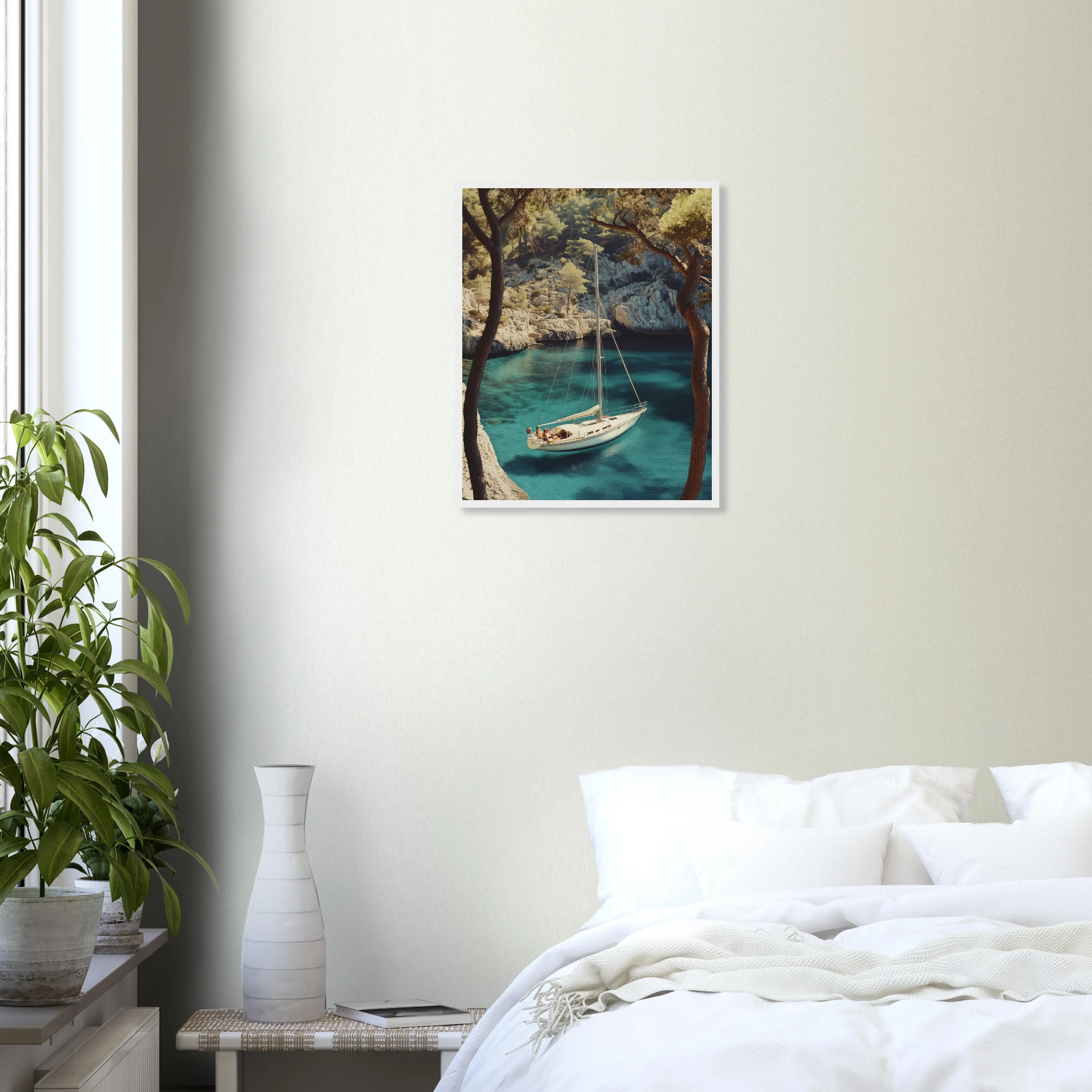
Staircase wall art is one of those decorating opportunities that most people either ignore or approach badly. The staircase wall is large, vertical, in constant view from multiple angles, and crossed dozens of times a day — which makes it one of the most impactful surfaces in the house. Get it right and it becomes the most interesting wall you own.
This guide covers the full picture: how to approach a staircase gallery wall, what sizes work, which styles hold up in this specific context, and how to arrange art on an angled wall without it looking accidental.
Why the Staircase Is One of the Best Walls in the House
The staircase wall has a few unusual advantages over other walls in the home. First, it’s typically the largest uninterrupted vertical surface — no windows breaking it up, no furniture pushed against it. Second, it’s experienced in motion: people pass it going up and down, seeing it from different angles and distances. Third, it connects floors — a gallery wall that extends from the ground to the upper landing creates a sense of continuity that no single-room wall can replicate.
The challenge is the diagonal. Most staircase walls follow the slope of the stairs, which makes conventional grid arrangements feel wrong and forces you to think differently about layout. That challenge, once understood, becomes an advantage — the staircase wall almost forces you into a more considered, dynamic arrangement than you’d attempt elsewhere.
The Gallery Wall Staircase — How to Get It Right
The staircase gallery wall is the most popular approach — and the one most people execute poorly. The most common mistake is treating it like a living room gallery wall and using a rectangular arrangement. On a staircase, a rectangle of frames looks static and disconnected from the diagonal energy of the space.
The arrangement that works: follow the staircase line. The frames should step up or down along the wall, mirroring the rise of the stairs. This doesn’t mean placing them on a rigid diagonal — it means the visual centre of gravity of your arrangement follows the stair angle, even if individual frames are hung straight and level.
For a typical staircase of 6–10 steps, a grouping of 4–8 frames works well. Mix sizes but keep the frame style consistent — matching black frames, or all natural wood, or all white. One strong anchor piece (the largest frame, 60cm+ wide) near the centre or lower end of the arrangement, and smaller pieces building up around it.
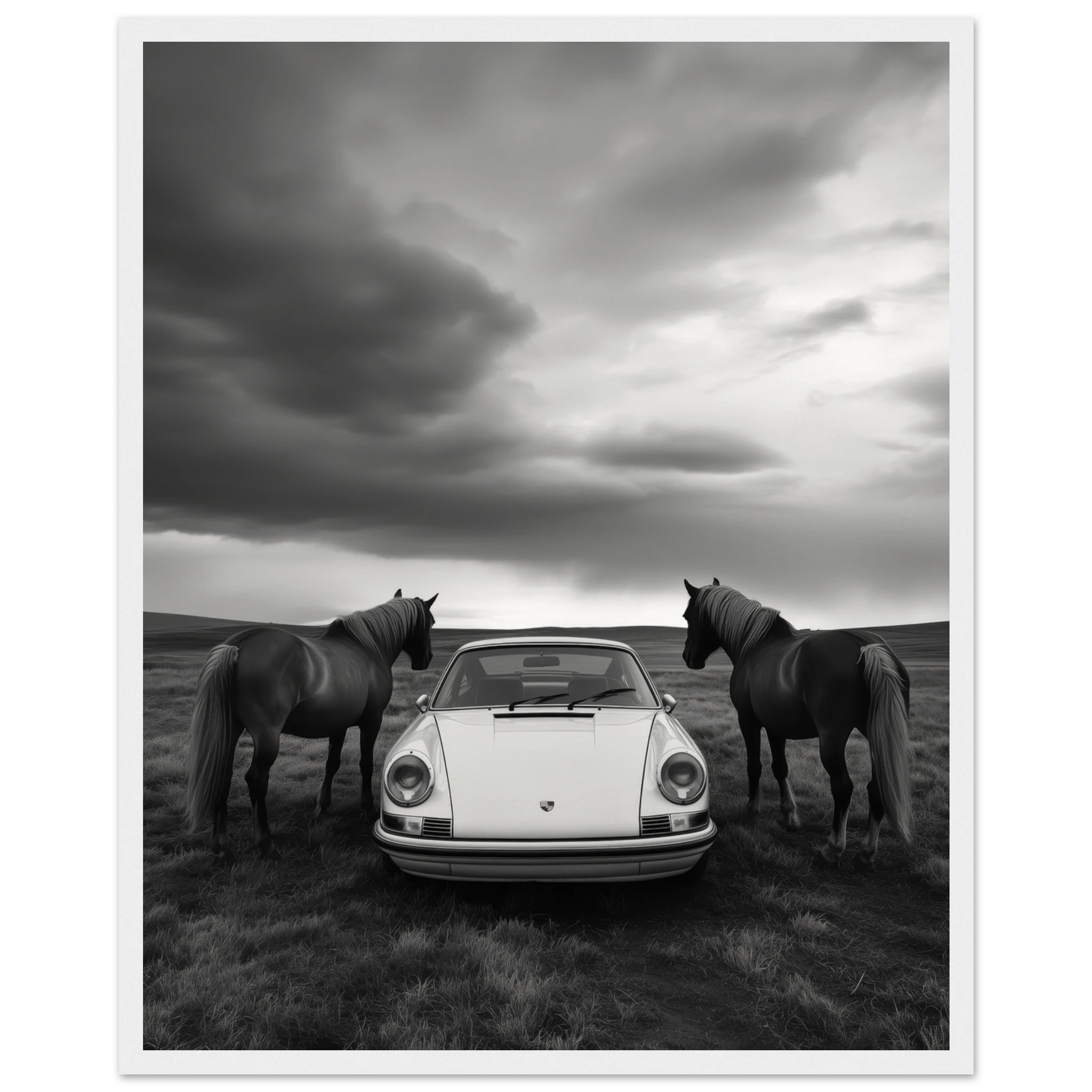
A piece like the Porsche 911 and the Black Horses Framed Print works as an anchor piece in a staircase gallery — the drama of the composition and the strong contrast hold attention from across a stairwell, even when viewed briefly in passing.
What Size Art Works on a Staircase Wall
Size rules for the staircase are different from other rooms because you’re filling a tall, often narrow vertical strip — and you’re filling it with movement in mind.
For a gallery wall arrangement: use a mix of sizes, with the largest piece in the 50×70cm to 70×100cm range. Smaller pieces (30×40cm or 40×50cm) should sit around it rather than dominating. The arrangement as a whole should feel generous — too small and it looks like pictures stuck on a wall rather than a considered installation.
For a single statement print above a half-landing or on a feature wall adjacent to the stairs: go large. A single print on a staircase wall needs to hold its own against the scale of the space. 70×100cm is a good minimum; 80×120cm or larger is better if the wall allows it.
Vertical formats tend to work especially well in staircase contexts — they echo the upward movement of the stairs and fill the height of the wall more naturally than wide horizontal prints.
Style and Subject — What to Hang on a Staircase
The staircase is a transitional space — you pass through it, you don’t linger. That changes what kinds of art work well there.
Bold, readable subjects are your friend. Staircase art is experienced at a glance, often from a moving vantage point. Prints with strong graphic impact — a subject that reads clearly from 3–5 metres — work much better than prints that reward close inspection.
Narrative subjects add something every time you pass. A vintage car photograph, a Mediterranean landscape, an architectural study — these are prints you notice something new in on the tenth viewing. That quality matters more on the staircase than anywhere else.
Themed collections suit the staircase particularly well. A run of automotive prints, all in the same frame style, building up the wall as you climb. Or a Mediterranean series — coastlines, courtyards, landscapes — that tells a story from the ground floor to the landing. The staircase gives you enough wall space to build a coherent collection rather than placing individual pieces.
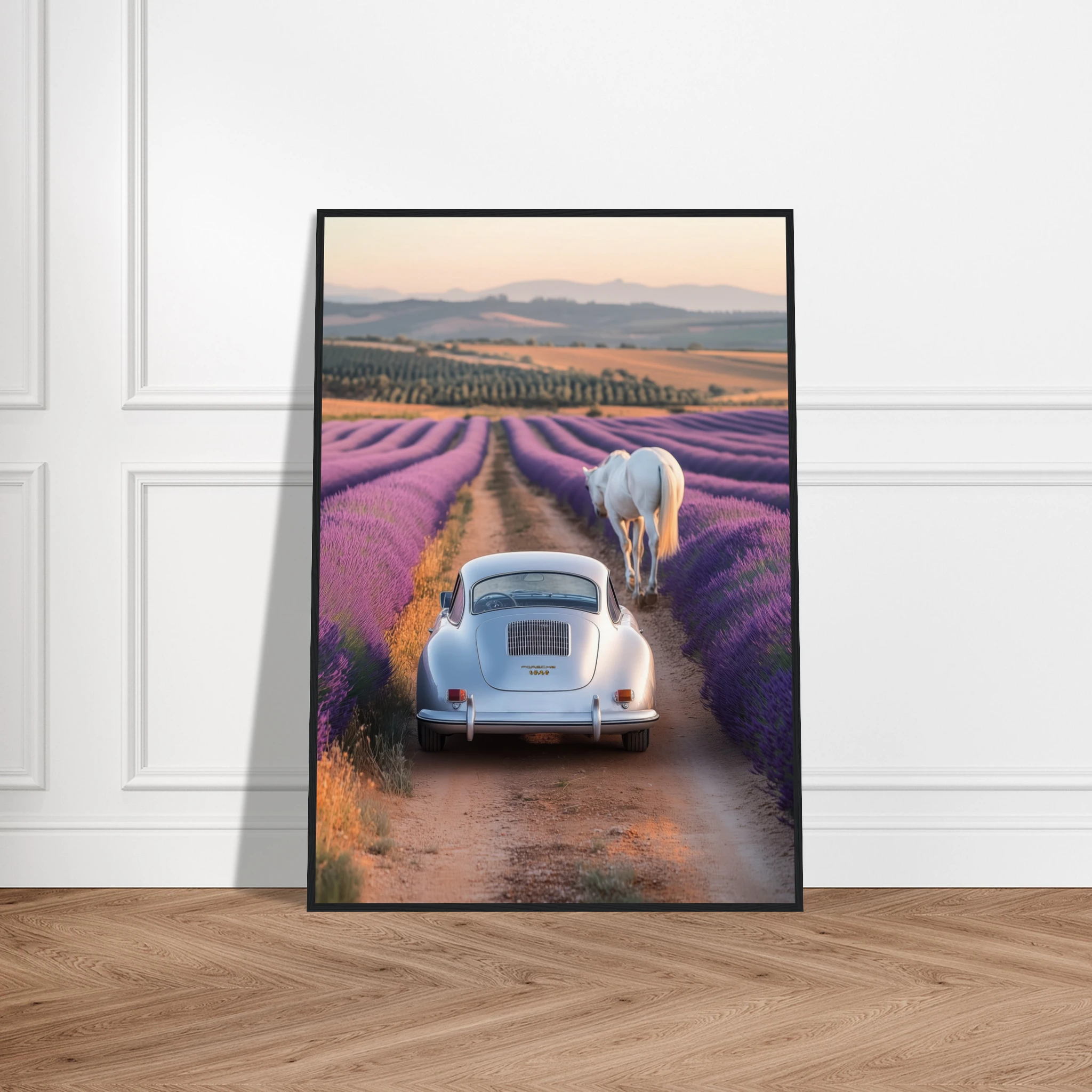
The Porsche 356 and Lavender Fields Framed Print is a strong staircase piece — the soft lavender palette and the classic car create a quietly romantic image that rewards the passing glance and holds up on repeated viewing.
How to Arrange Art on an Angled Staircase Wall
The practical question everyone runs into: how do you lay out frames on a wall that isn’t flat-floor level?
Keep frames level, follow the stair line with spacing. Each individual frame should be hung perfectly level — tilted frames look accidental, not designed. What follows the diagonal is the overall arrangement: the centre of each frame rises incrementally as you go up the stairs.
A practical method: cut paper templates of each frame, tape them to the wall with painter’s tape, and step back to assess the arrangement before making a single hole. Adjust the templates until the composition feels right, then use the template positions to mark your hanging points.
Consistent spacing is more important than perfect symmetry. Keep the gap between frames consistent — 8–12cm is a good range. Consistent gaps create visual rhythm even when the frame sizes vary.
Eye level from the stairs, not the floor. The most common error: hanging staircase art at eye level when standing at the bottom, which means the art is too high to read when you’re halfway up. Aim to position the centre of your arrangement at eye level from the midpoint of the staircase — roughly the 4th or 5th step.
Single Statement Piece vs. Gallery Wall
The gallery wall gets all the attention, but a single large statement print on a staircase wall is often the stronger choice — particularly in a contemporary or minimal interior where a cluster of frames would feel busy.
The best location for a single piece: a half-landing wall, or the wall directly facing the stairs at the top. These spots are seen head-on at close range, which makes them ideal for a print you actually want to look at rather than pass by.
If you have a long, uninterrupted staircase wall with no landing break, the gallery arrangement usually makes more sense — it fills the space more naturally and gives the eye somewhere to travel as you climb.
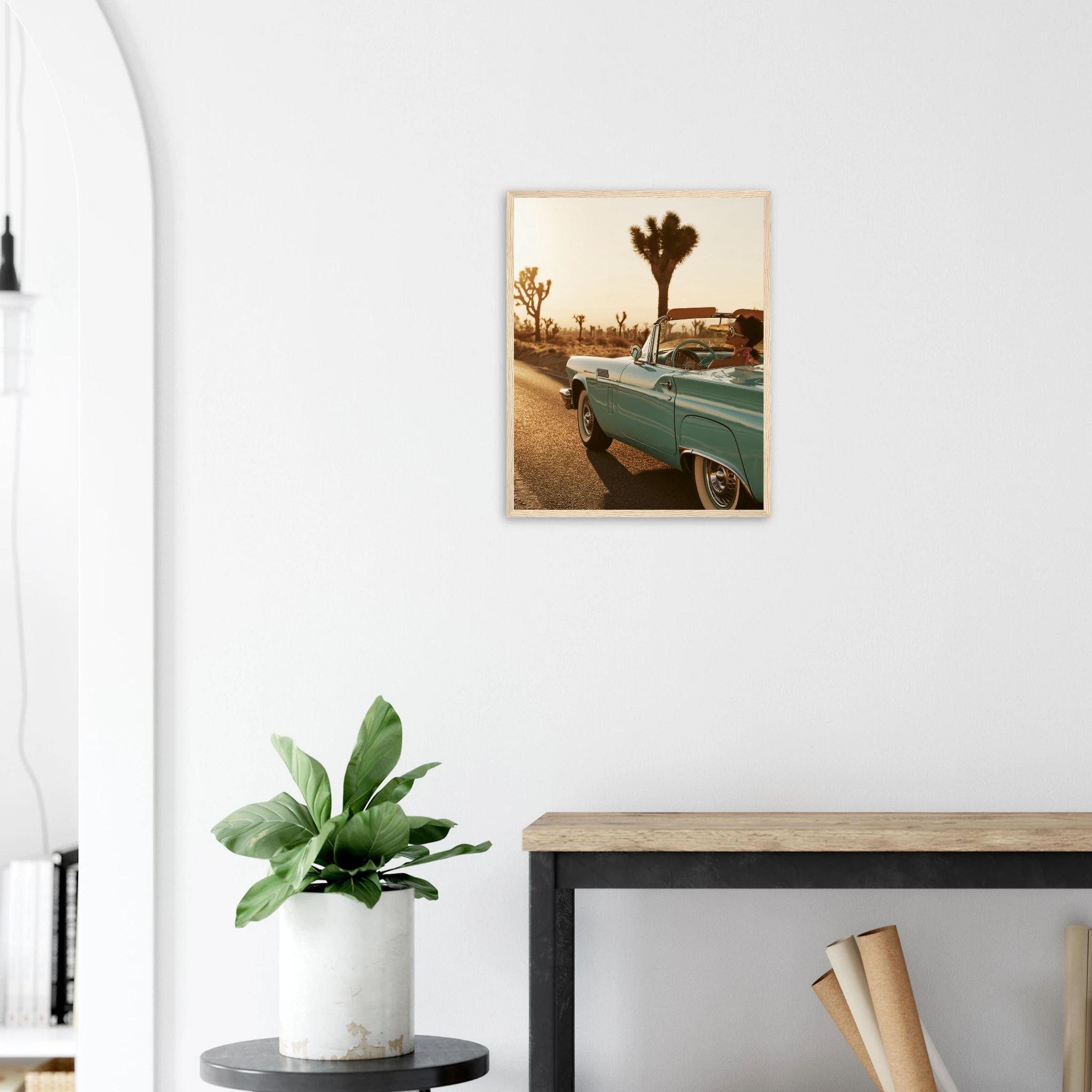
The Desert Thunderbird Framed Print works particularly well as a single statement at a half-landing — the warm desert palette and the graphic presence of the classic American car make it a print that stops you on the stairs rather than one you pass without noticing.
Read Also
→ Hallway Wall Art: First Impressions Matter
→ Above the Fireplace Wall Art: How to Choose the Print That Earns Its Place
→ Gallery Wall Ideas 2026: Beyond the Basic Grid
FAQ — Staircase Wall Art
What kind of art looks good on a staircase wall?
Art with strong graphic impact works best — subjects that read clearly from a distance and at a glance. Bold landscapes, vintage car prints, architectural subjects, and graphic illustrations all perform well. Avoid prints that rely on fine detail or subtle colour variation, which gets lost on a staircase wall viewed in motion.
How do you arrange pictures on a staircase wall?
Keep each frame perfectly level, but step the overall arrangement up with the angle of the stairs. Use paper templates taped to the wall to plan the layout before making holes. Maintain consistent gaps between frames (8–12cm) and aim to position the centre of the arrangement at eye level from the middle of the staircase.
How big should staircase wall art be?
For a gallery arrangement, use a mix of sizes with at least one anchor piece of 50×70cm or larger. For a single statement print, go as large as the wall allows — 70×100cm is a useful minimum for a staircase context. The staircase scale means art almost always benefits from being bigger than you initially think.
Should staircase art all match or mix styles?
Consistent framing (all in the same frame style or colour) with mixed print styles and subjects works well and creates cohesion without monotony. Mixing both frame styles and print styles tends to look chaotic on a staircase. Pick one variable to mix and keep the other consistent.
Have a high ceiling above the stairs? Read our guide to Wall Art for Tall Walls and Double-Height Spaces.