
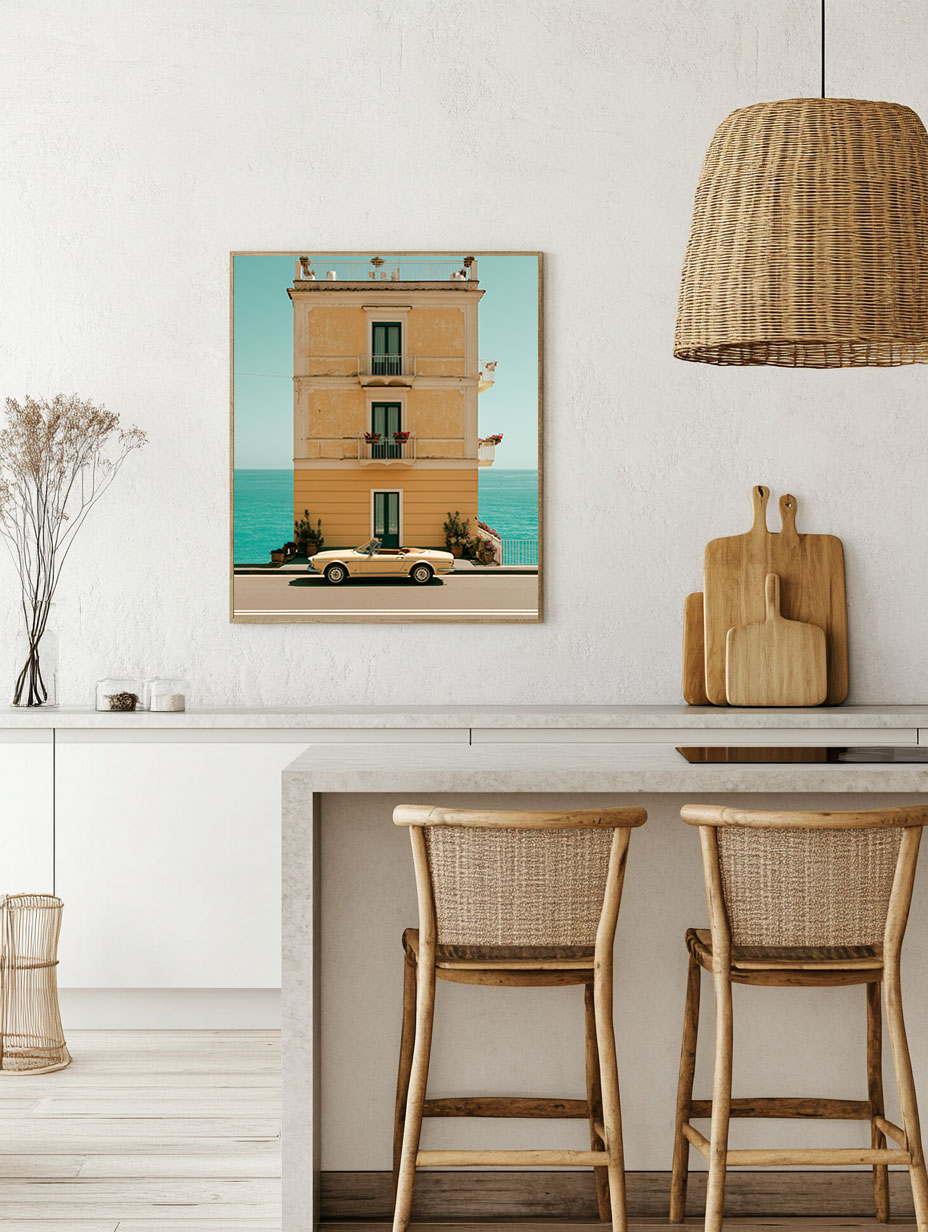
There is a scale at which a print stops being decoration and starts being architecture. It’s not a hard line, but you know it when you cross it. A 70×100 cm print above a sofa doesn’t hang on the wall — it becomes part of the wall. The room organises itself around it.
Large format art prints are the single most underused tool in interior design. Most people go too small — not out of taste, but out of caution. This is the case for going big.
Why Scale Changes Everything
The same image at 30×40 cm and 70×100 cm is not the same image. At small scale, you’re looking at a photograph. At large scale, you’re looking at a scene. The difference is immersive: a large format art print creates depth in a room, gives a wall a focal point, and anchors the furniture beneath it.
Interior designers work with this instinctively — the rooms that photograph well, that feel resolved and considered, almost always have at least one large-format piece. It’s not a coincidence.
The Maths of Wall and Print
A useful rule: the print should occupy between 60% and 75% of the wall width above the furniture beneath it. For a standard 200 cm sofa, that’s a print between 120 and 150 cm wide — or a framed 70×100 cm print, which at 80+ cm wide with frame hits the lower end of that range perfectly.
For a feature wall with no furniture in front of it, larger is almost always better. A single oversized wall art print — 100 cm wide or more — on an otherwise bare wall is one of the most impactful things you can do to a room.
Hang height matters as much as size. Centre the print at eye level — approximately 145-150 cm from the floor to the centre of the print. Above a sofa or bed, leave 15-20 cm between the top of the furniture and the bottom of the print.
Which Subjects Work at Large Format
Not every image scales. A print that works at 30×40 cm can fall apart at 70×100 cm if the composition isn’t built for it. The subjects that hold at large format share a few qualities: clear compositional hierarchy, strong subject-background separation, and enough tonal depth to reward looking at from across a room.
Wildlife: Animals with presence and stillness — an elephant on a beach, a leopard in bougainvillea — scale beautifully. The subject carries enough weight to fill the format without the composition feeling stretched.
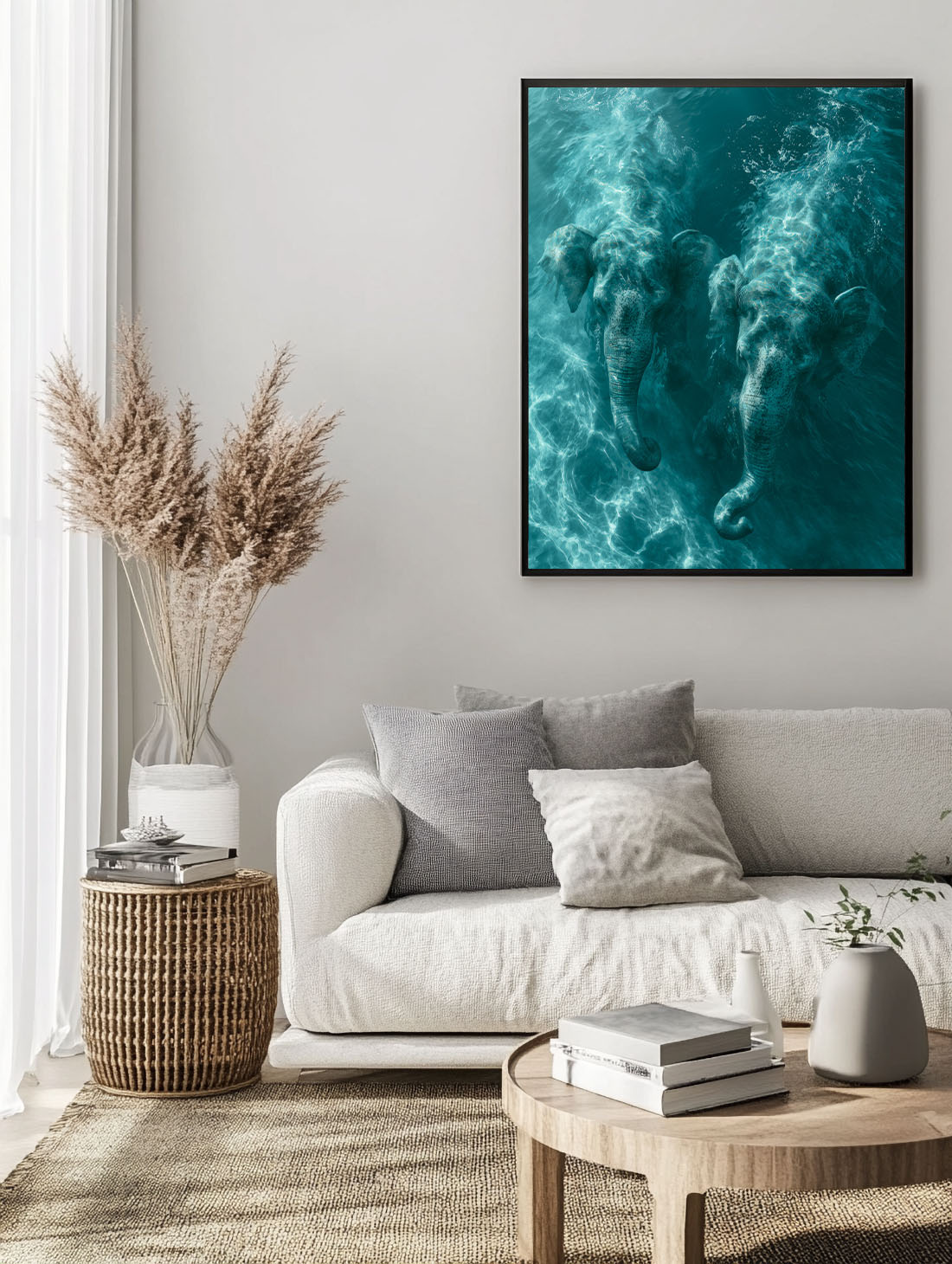
Water and landscape: The Mediterranean at large format becomes a window. A 70×100 cm poolside print gives a room a horizon. The blue field holds across the scale without feeling empty.
Vintage scenes: A 1960s beach scene at large format has the quality of a cinema still — you’re inside the scene rather than looking at it. The grain and warmth of the image amplify with scale.
Canvas vs. Framed at Large Format
At 70×100 cm, both formats work — but differently. Canvas without a frame has a lightness that suits minimal interiors: the image continues around the edges, there’s no visual interruption, and the piece reads as contemporary and collected. A framed print at the same size feels more formal, more deliberate — the frame creates definition and suits rooms with more traditional or layered aesthetics.
Both are available at Atelier Marbella in 70×100 cm. The choice comes down to the room, not the image.
Choosing Your Large Format Size
Large does not have to mean enormous. In practice, there are three sizes that cover most rooms. At 50×70 cm, a print is the entry point to large format: strong enough for a narrow hallway wall or the space beside a window. At 70×100 cm, it becomes the statement size that suits most sofas, beds and dining walls. Above that, 100 cm and over is for open-plan spaces, double-height walls and anywhere the print is the only thing on the wall.
If you are between two sizes, go up. A print that is a little too big looks deliberate, while one that is a little too small looks hesitant. The one exception is a very low ceiling, where a tall portrait print can feel crowded. In that case, choose a landscape orientation and let it run wide rather than tall.
Frame depth matters too. A framed print adds roughly 3 to 4 cm on every side, so a 70×100 cm print reads closer to 77×107 cm on the wall. Always measure the finished size, not the print size, before you commit.
Large Format Prints for Every Room
In a living room, pair a statement piece with a long, low sofa and let it do all the talking. Sierra Nevada from the Shore works beautifully here: a wide horizon, calm tones and enough detail to reward a second look from across the room.
In a bedroom, a single large print above the headboard replaces a gallery wall and keeps the space restful. Es Vedrà has the atmosphere for it, a slow, quiet scene that suits low light and soft linen.
In a dining area, think about what you see while seated. A bold, graphic composition like Marbella Nights gives dinner a backdrop and a conversation starter. You can browse more options in our Mediterranean Mood collection.
Large Format Prints at Atelier Marbella
Every print in the Atelier Marbella collection is available at 70×100 cm — the format built for walls that mean it. The Elephant Duet in the Sea at this scale becomes genuinely monumental — two elephants against Mediterranean light, filling a wall with the kind of stillness that only large format delivers. The Bougainvillea Leopard and Sea at 70×100 cm gives a living room a focal point it won’t outgrow.
Browse the full collection and filter by size at Atelier Marbella.
Read also:
→ Wall Art Trends 2026: What’s Actually Worth Buying
→ Bedroom Wall Art: How to Choose a Print That Changes a Room
Frequently Asked Questions
What size is considered a large format art print?
In wall art, large format generally starts at 50×70 cm and reaches full statement scale at 70×100 cm and above. Anything over 100 cm on the longest side is considered oversized.
Will a large print look too big for my room?
Rarely. A print should fill about 60 to 75% of the width of the furniture beneath it. If it looks too large on paper, tape a paper template of the size to the wall for a day before you decide.
Is canvas or framed better for large formats?
Both work. A framed print feels more refined and protects the surface, while canvas is lighter, glare-free and easier to hang. For wide, open walls we usually recommend framed.
How high should I hang a large print?
Centre it at about 145 to 150 cm from the floor. Above a sofa or bed, leave 15 to 20 cm between the furniture and the bottom edge of the frame.