The wall art market moves faster than most people realise. What felt current two years ago — mass-market abstracts, overexposed typography prints, canvas prints of cities in flat-colour palettes — has dated visibly. The rooms that look considered in 2026 are operating on a different set of references entirely.
Here’s what’s actually happening in wall art trends 2026 — and what’s worth buying versus what you’ll be over in eighteen months.
Quiet Luxury Comes to the Wall
The dominant interior trend of 2025 has fully matured into wall art choices. Quiet luxury on a wall means: one large-format print, considered subject matter, restrained palette, premium finish. It means editorial photography over graphic illustration. Animals in stillness over cute animal art. Mediterranean light over tropical colour.
What you’re buying in quiet luxury wall art is the feeling that the choice was intentional — that the print was collected, not ordered. That register is harder to fake than it looks, and it’s why the right subject and finish matters more than ever.
Oversized Formats — the Trend That’s Becoming a Standard
The shift to large-format wall art prints has been building for five years. In 2026 it’s no longer a trend — it’s the default expectation for any interior that takes itself seriously. A 70×100 cm print above a sofa is now what a 50×70 cm print was five years ago: the baseline.
The rooms that look dated are the ones with too many small prints. The rooms that look current have one large piece, positioned correctly, and enough wall around it to breathe.
Mediterranean and Coastal Aesthetics — Still Going, Differently
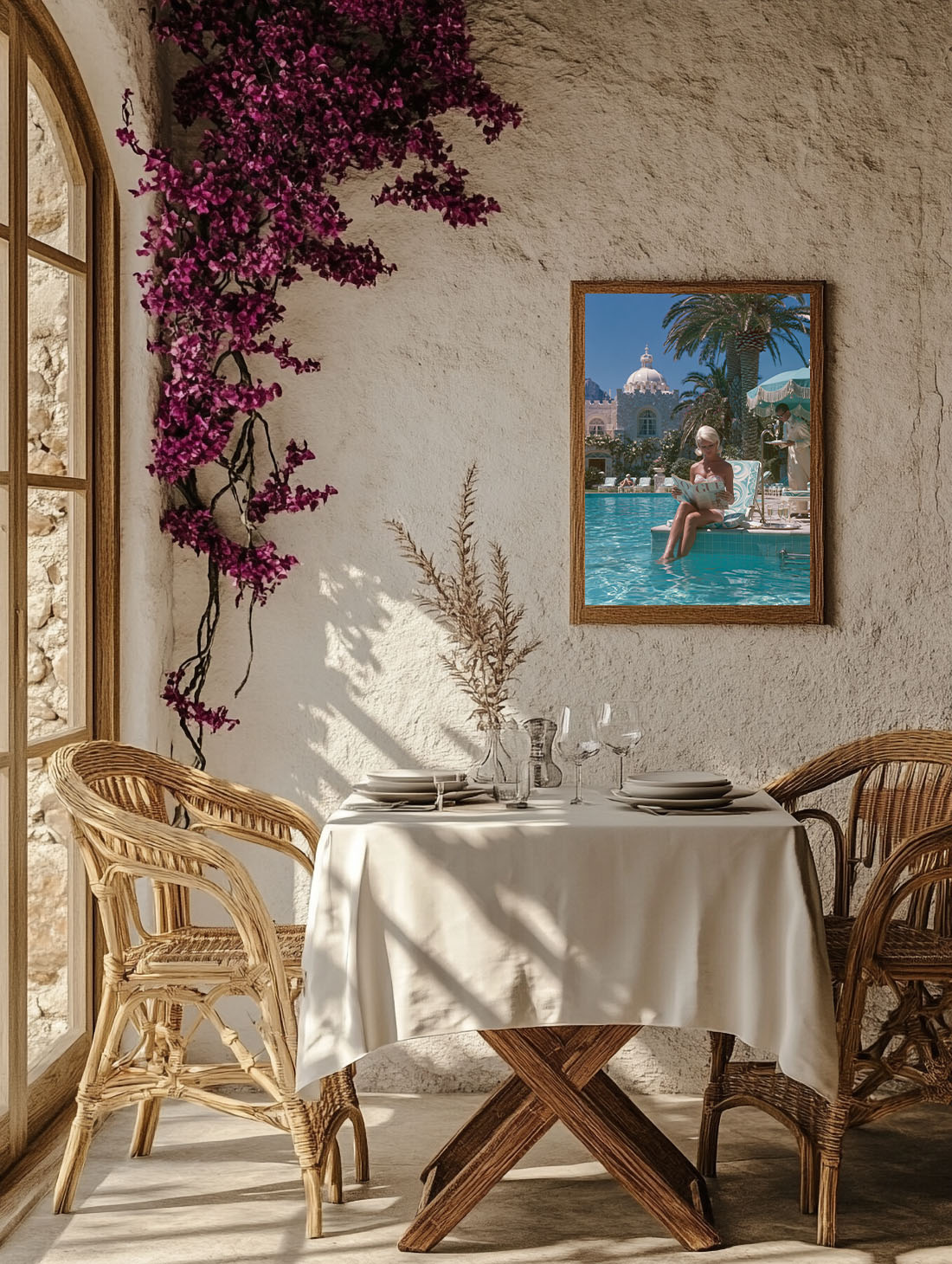
Mediterranean wall art had a moment in 2023-2024 that produced a lot of generic blue-and-white prints. That wave has receded. What’s replaced it is more specific: the Mediterranean as a mood rather than a location. The particular light of the Côte d’Azur at 6pm. A pool in Marbella with no one in it. A vintage beach scene from the 1960s.
The trend has moved from geography to atmosphere. Prints that capture a specific feeling — the ease of a Mediterranean summer, the quiet of afternoon light on water — are outperforming the generic coastal imagery that flooded the market two years ago.
Botanical Prints — The New Neutral
Botanical art prints have quietly become the new neutral — the safe choice that’s actually good. Where the abstract beige canvas was the default safe choice three years ago, the botanical print has replaced it. It reads as considered, it works in any room, and the best examples feel collected rather than decorative.
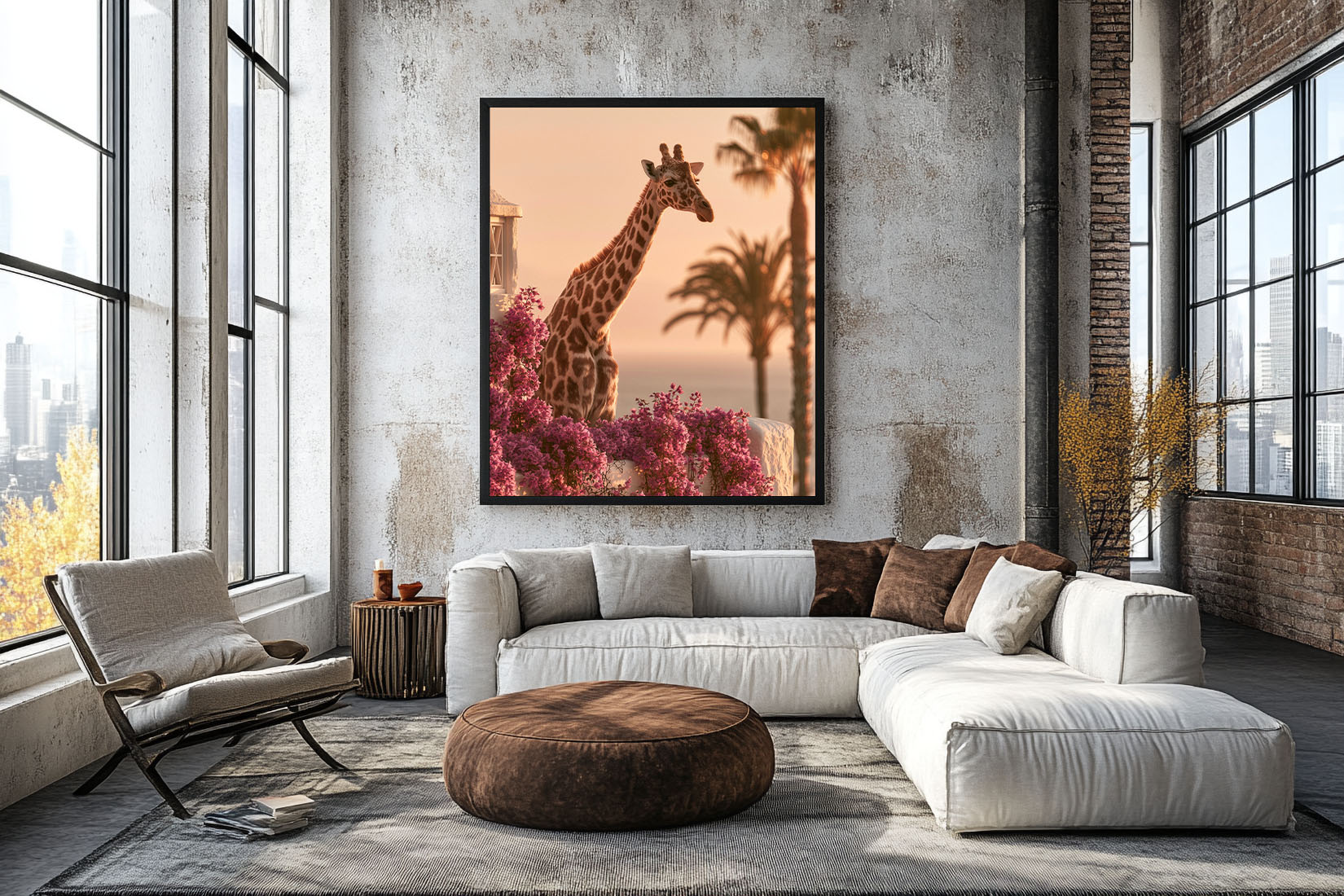
The wall art trends 2026 version of botanical isn’t the pressed-flower illustration of ten years ago — it’s lush, atmospheric, Mediterranean-inflected. Bougainvillea, citrus, tropical leaves with depth and colour. Subjects that feel alive rather than archival.
What’s Actually Fading in 2026
Typography and quote prints. “Live Laugh Love” was the obvious casualty years ago. But even the more considered versions — single-word prints, minimalist type on linen — are reading as dated now. Words on walls are being replaced by images with presence.
Matching gallery walls. The perfectly curated grid of matching prints in matching frames had its peak around 2022-2023. What’s replacing it: one large anchor piece, or a deliberately eclectic collection that looks gathered over time.
Mass-market abstracts. The pale beige-and-terracotta abstract that appeared in every fast-fashion home edit from 2021-2024 is now the fastest way to date a room. Abstract wall art still works — but the version that’s working is specific and painterly, not generic and safe.
What to Actually Buy in 2026
The prints that will hold across the next five years share a few qualities: editorial rather than decorative, specific rather than generic, large rather than small, matte finish rather than glossy. Subjects with stillness and depth — wildlife, Mediterranean light, botanical subjects treated with seriousness — are the ones that age well.
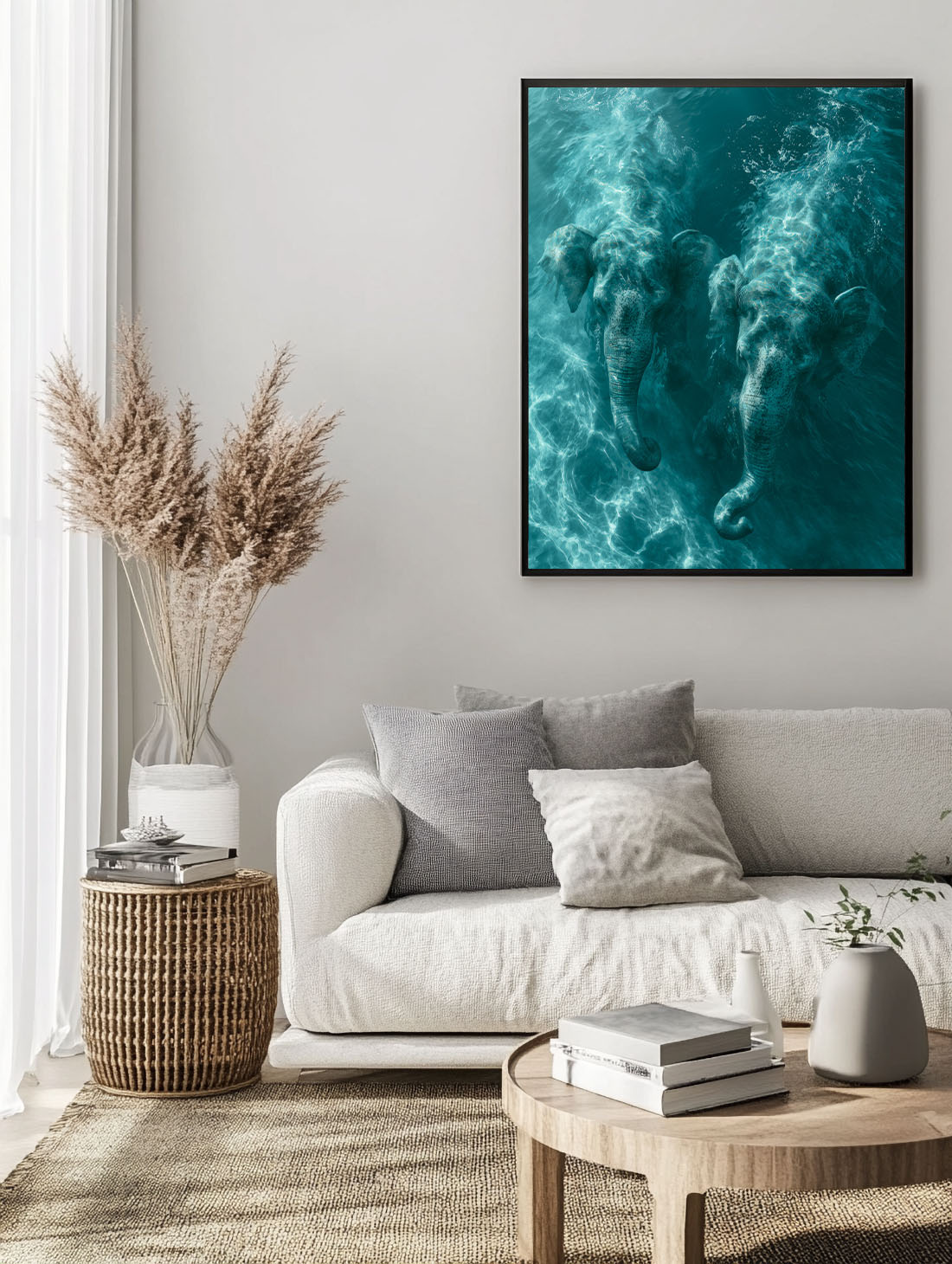
At Atelier Marbella, the collection is built exactly on these principles. The Elephant Duet in the Sea, the Bougainvillea Leopard and Sea, the 1960s Mediterranean Beach Scene — prints that are specific, considered, and built to last on the wall.
Read also:
→ Quiet Luxury in Interior Design: The Art Edit
→ Botanical Art Prints: The New Neutral for Modern Interiors
In This Article
- Quiet Luxury Is Here to Stay
- Oversized Prints: Scale Is the Statement
- Mediterranean and Coastal Art
- Vintage and Automotive Art Makes Its Move
- Gallery Walls, But With an Edit
- What to Skip in 2026
Quiet Luxury Is Here to Stay
In 2024, quiet luxury was a moment. In 2026, it has become a baseline. The look — understated, high-quality, intentional — has moved from fashion runways into interiors in a way that shows no signs of reversing. For wall art, this translates to one clear principle: one strong piece over several average ones.
What sells in this register is not decorative filler. It is art that reads as a decision — a large Mediterranean coastal print, a single vintage automotive piece, an abstract with genuine tonal depth. The quiet luxury buyer does not want to explain their wall. They want it to speak without effort.
The practical implication: invest in one print that anchors the room rather than three prints that fill it. Scale and quality of finish matter more than quantity.
Oversized Prints: Scale Is the Statement
One of the clearest wall art trends 2026 is the return to scale. After years of gallery walls made up of smaller pieces, the appetite for a single large format print — 70×100 cm and above — has grown significantly. This is partly driven by interior photography culture: oversized art photographs exceptionally well and has become a signifier of considered taste in high-end residential design.
The practical question for buyers is always proportion. A 50×70 cm print on a three-metre wall looks timid. A 70×100 cm print on the same wall reads as a choice. When in doubt, size up. A print that feels too large in your hands will almost always feel right on the wall.
Canvas works particularly well at large format — the texture adds presence and eliminates any sense of flatness that can affect large matte prints in certain lighting conditions.
Mediterranean and Coastal Art — Still Going Strong
Mediterranean wall art has been a dominant category for three years and continues to lead in 2026, but the aesthetic has refined. The early wave of generic Santorini blue domes and mass-produced coastal prints has peaked. What is growing now is more specific: the light of a Provençal calanque, the ochre walls of an Andalusian courtyard, the stillness of a sailing boat in a turquoise cove at anchor.
The demand is for place, not category. Buyers want to feel the specific geography of a southern afternoon — not just “the sea.”
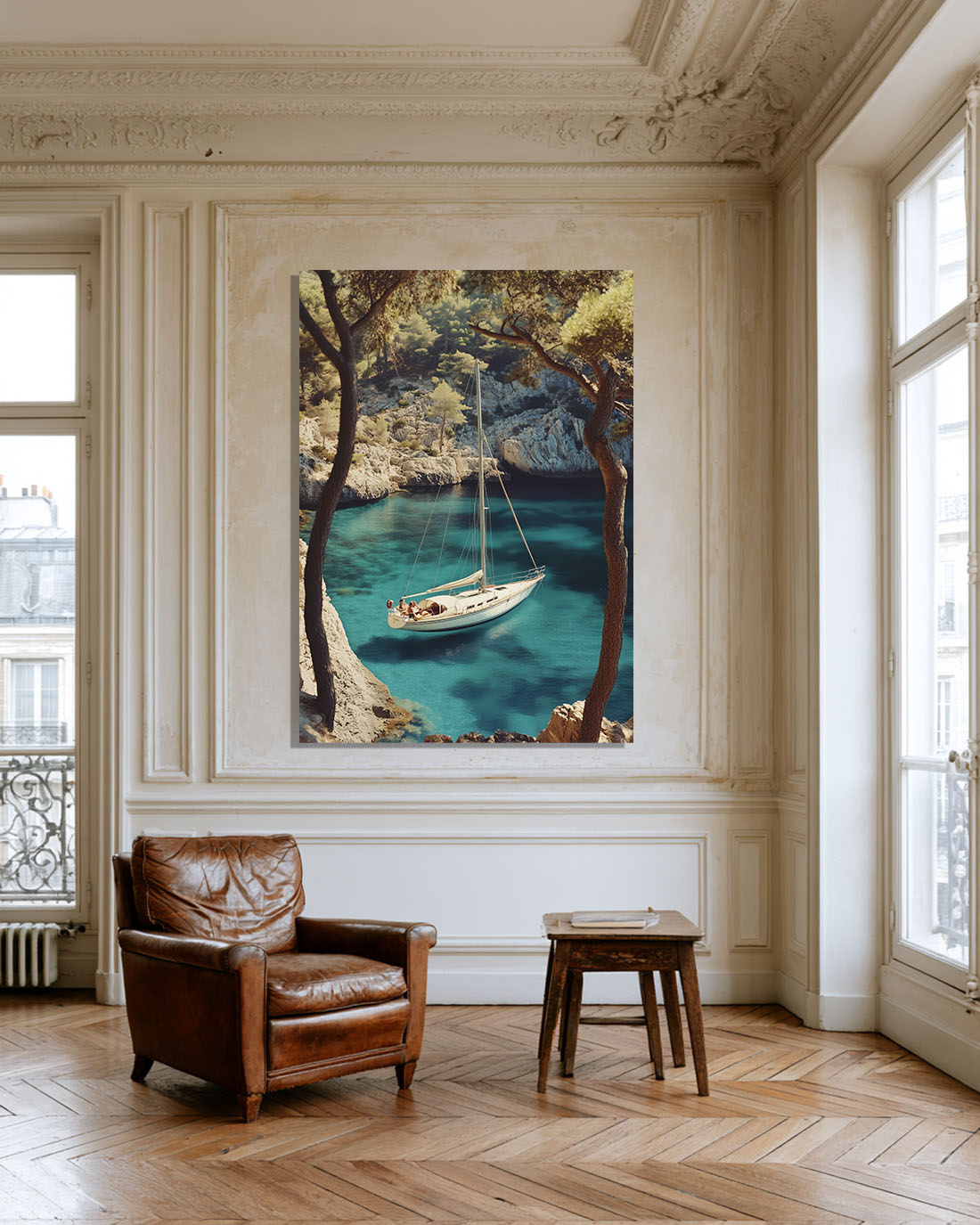
The palette has also shifted. Saturated turquoise and deep cobalt remain strong, but warm terracotta, burnt orange, and dusty rose are gaining ground — particularly for living rooms and dining spaces where the evening light calls for warmth rather than cool.
→ Browse Mediterranean Art Prints
Vintage and Automotive Art Makes Its Move
The most interesting shift in wall art trends 2026 is the mainstream arrival of vintage automotive art. What was previously a niche category — posters for enthusiasts, garage walls, collector rooms — has moved into living rooms, home offices, and even primary bedrooms.
The aesthetic logic is sound. A mint-green Ford Thunderbird crossing the Mojave desert carries the same graphic clarity as a mid-century travel poster — strong silhouette, clean palette, an immediately readable mood. It works as art before it works as automotive content.
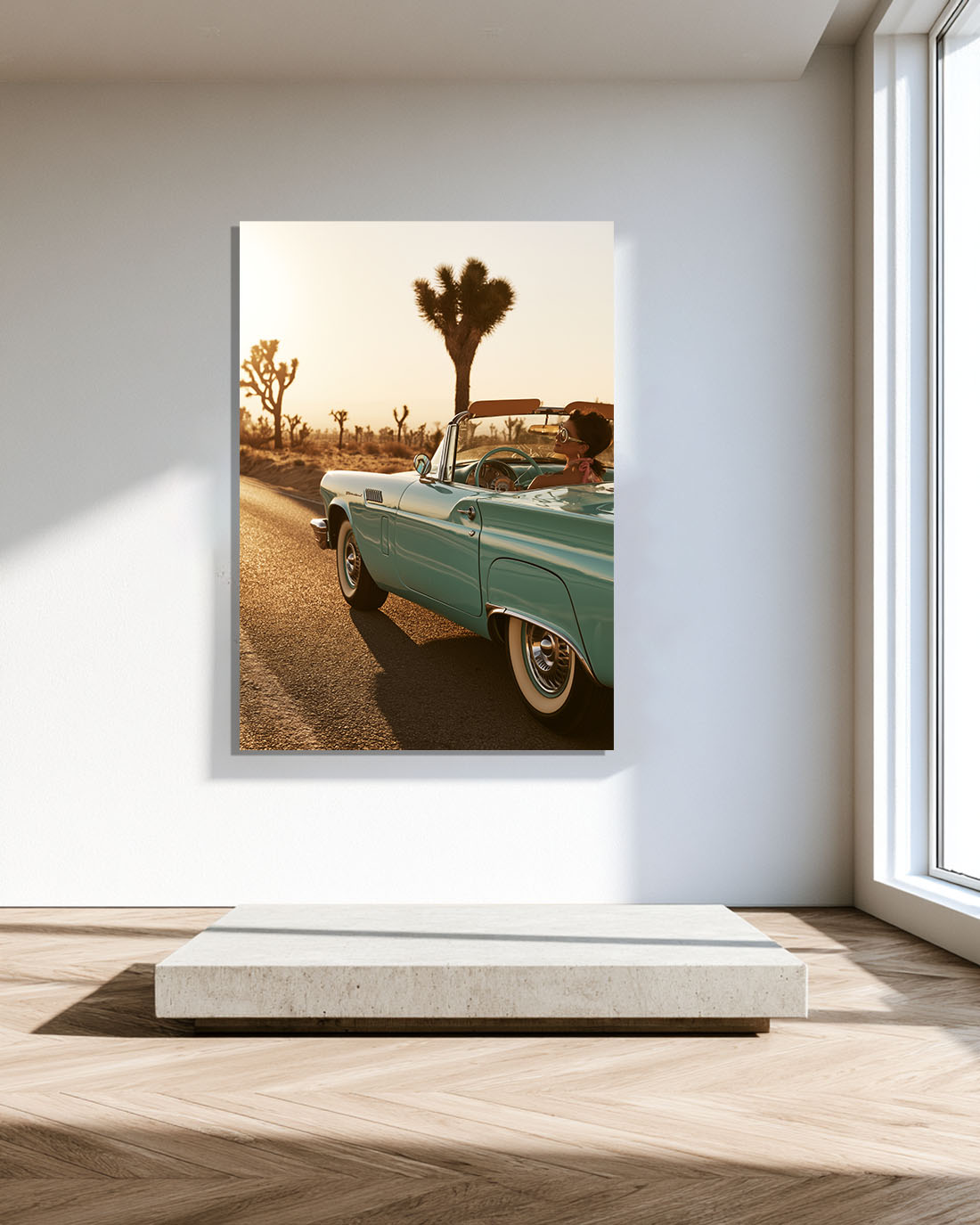
The cars that work as wall art in 2026 are not the hyper-documented supercars. They are the ones with narrative — a classic Porsche on a mountain road, a Thunderbird at sunset, a Ferrari at the edge of a hairpin. The image needs a sense of place and time, not just the vehicle.
→ Browse Automotive Art Prints
Gallery Walls, But With an Edit
Gallery walls did not disappear — they grew up. The 2022 version of a gallery wall was maximalist and inclusive: every frame, every size, every style. The 2026 version is edited. Three to five pieces maximum. A coherent palette. Consistent framing. One clear visual hierarchy where one piece anchors the others.
The trend is particularly strong in dining rooms and hallways — spaces where the wall is the primary surface and deserves proper composition. Living rooms, which previously hosted the gallery wall, are now more likely to feature a single oversized piece as the focal point.
If you are building a gallery wall in 2026, the rule that holds is this: edit before you hang. Choose a lead piece first. Everything else is context.
What to Skip in 2026
A few categories have peaked and are now more likely to date a room than define it. Generic botanical prints in a matching series — three identical frames, gradient backgrounds — feel mass-produced rather than considered. Typographic wall art (“Live, Laugh, Love” and its descendants) remains popular in certain markets but has lost any editorial credibility. And extremely saturated colour-pop prints, which were everywhere in 2023, read as trend-chasing rather than taste.
The clearest filter for 2026: if the same print could appear in a hotel corridor, it probably does not belong in a home that is meant to feel personal.
The wall art trends 2026 that are worth acting on share a common quality: specificity. A print from a specific place, in a specific light, with a specific mood. That is what holds a room — and a year.