
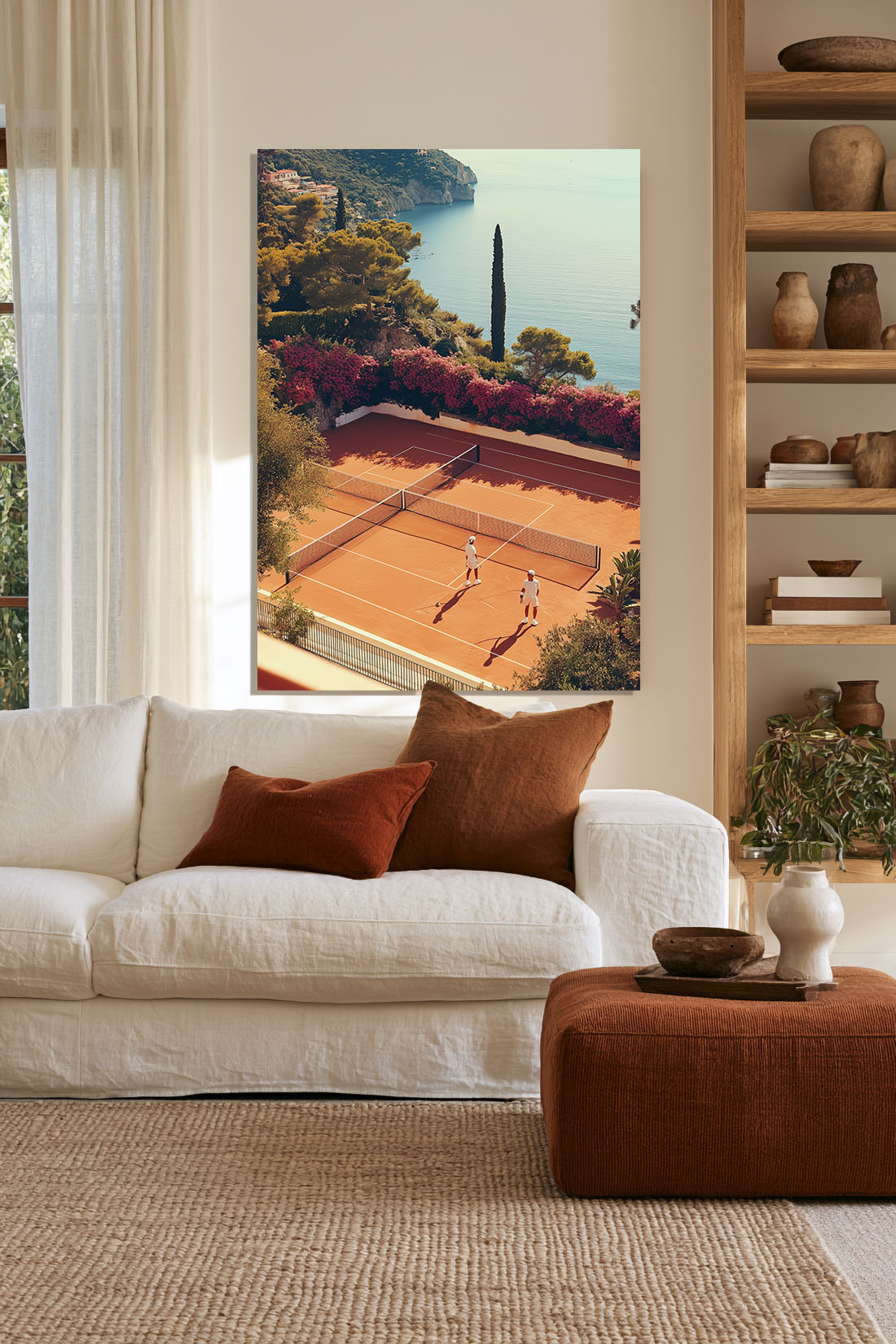
Tennis wall art occupies a very specific cultural space — and the best of it knows exactly what it is. Not sports memorabilia. Not a match programme framed in acrylic. Something closer to what Slim Aarons was doing when he photographed the poolside at the Bel-Air Hotel: sport as lifestyle, as aesthetics, as the kind of image that belongs on a wall in a house that takes design seriously.
The clay court, in particular, has always been more than a playing surface. Roland Garros. Monte-Carlo. Those private courts tucked behind the white walls of Riviera villas, half-hidden by bougainvillea and pine. There’s a visual intelligence to terracotta and white lines that translates directly from the court to the interior — and the best tennis wall art captures exactly that.
Why Tennis Works as Interior Art
The argument for tennis as a serious subject for wall art is straightforward once you look at the right images. An aerial view of a clay court at golden hour isn’t a sports photograph — it’s a study in colour, geometry and light. The terracotta surface. The white lines cutting precise angles. The long shadow of the net post at 6pm. These are compositional elements that work in a room the same way a Hockney pool painting works: the subject is the setting, and the setting is the lifestyle.
Tennis also carries a cultural specificity that most sports don’t. It’s associated with a particular world — Riviera villas, white linen, Mediterranean afternoons that stretch too long. That association is precisely what makes the best tennis wall art function as more than decoration. It says something about the space it’s in, and the life that space is built around.
The Aerial View: A New Approach to Court Photography
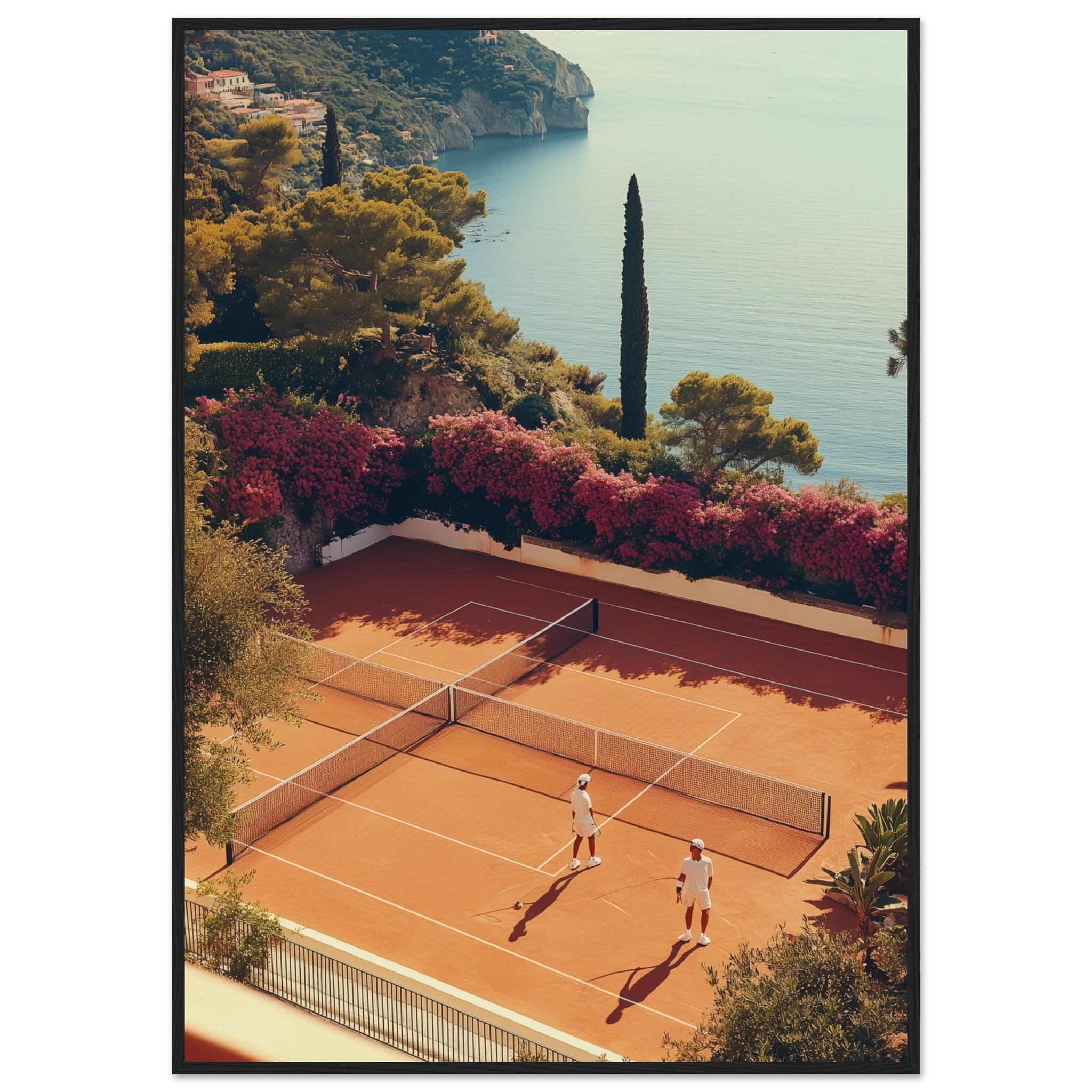
The most compelling tennis prints currently available aren’t ground-level action shots. They’re aerial — the court seen from above, reduced to its essential geometry: the rectangle, the lines, the surface colour, the surrounding landscape compressed to a border. From above, a clay court becomes almost abstract. Almost a painting.
This approach puts tennis wall art in conversation with Gray Malin’s aerial beach photography — the same logic, the same graphic intelligence applied to a different subject. The court replaces the beach club. The terracotta replaces the sand. The geometry of play replaces the geometry of loungers and umbrellas. The result is prints that function as genuine art objects, not just sports images.
The Riviera Clay Court print at Atelier Marbella takes exactly this approach — a photorealistic aerial view of a clay court at golden hour, the terracotta glowing, the white lines precise against the surface, the surrounding Mediterranean landscape visible at the edges. No players. Just the court, the light, and the moment.
Clay vs. Hard Court: Which Works Better on a Wall?
If you’re choosing tennis wall art for an interior, the surface matters more than you might expect — not for sporting reasons, but visual ones.
Prints that work here: the Riviera Clay Court — Mediterranean Tennis Framed Print, the 1960s Mediterranean Beach Scene Framed Print and the White Hat Infinity Pool Framed Print — each available as a framed print, ready to hang. Browse the Mediterranean Mood collection for more.
Clay courts are the stronger subject for residential interiors. The terracotta palette — warm ochre, burnt sienna, dusty rose at golden hour — maps naturally to Mediterranean, warm contemporary and natural materials aesthetics. The surface has texture in photographs, depth in prints. Against white walls, the terracotta reads as colour. Against warmer walls, it reads as warmth.
Hard courts (the blue US Open surface, the green of Wimbledon) produce more graphic, higher-contrast images that suit minimal and design-forward interiors. The colour palette is cooler and more limited — which can be a strength in the right space, a weakness in a warmer one.
Grass courts — Wimbledon, the English country club aesthetic — suit very specific interior contexts. They’re at home in a traditional British interior or a cricket-club library. In a Mediterranean or contemporary space, they create visual tension rather than cohesion.
Where to Hang Tennis Wall Art
Tennis prints are versatile in a way that other sports art isn’t, precisely because the best of them don’t read as sports art at all. They read as photography or aerial art or Mediterranean lifestyle imagery — which means they sit comfortably in spaces where a football poster would look out of place.
Living room: A large-format clay court print on a white wall works as a statement piece with the same authority as a landscape or abstract. Go to 70×100cm minimum — the aerial perspective needs space to reveal its depth and detail.
Study or home office: Tennis wall art brings a particular energy to a workspace — focused, precise, subtly competitive. The court’s geometry complements a desk-centred space without dominating it.
Hallway: The elongated proportions of a hallway suit a tall vertical print perfectly. Encountered at close range as you move through the space, a large tennis print has an impact that a smaller piece would never achieve.
Games room or pool area: The obvious choice — but also the one where you can go largest and most graphic. A 100×140cm aerial court print in a games room is a statement that needs no explanation.
Framing Tennis Wall Art
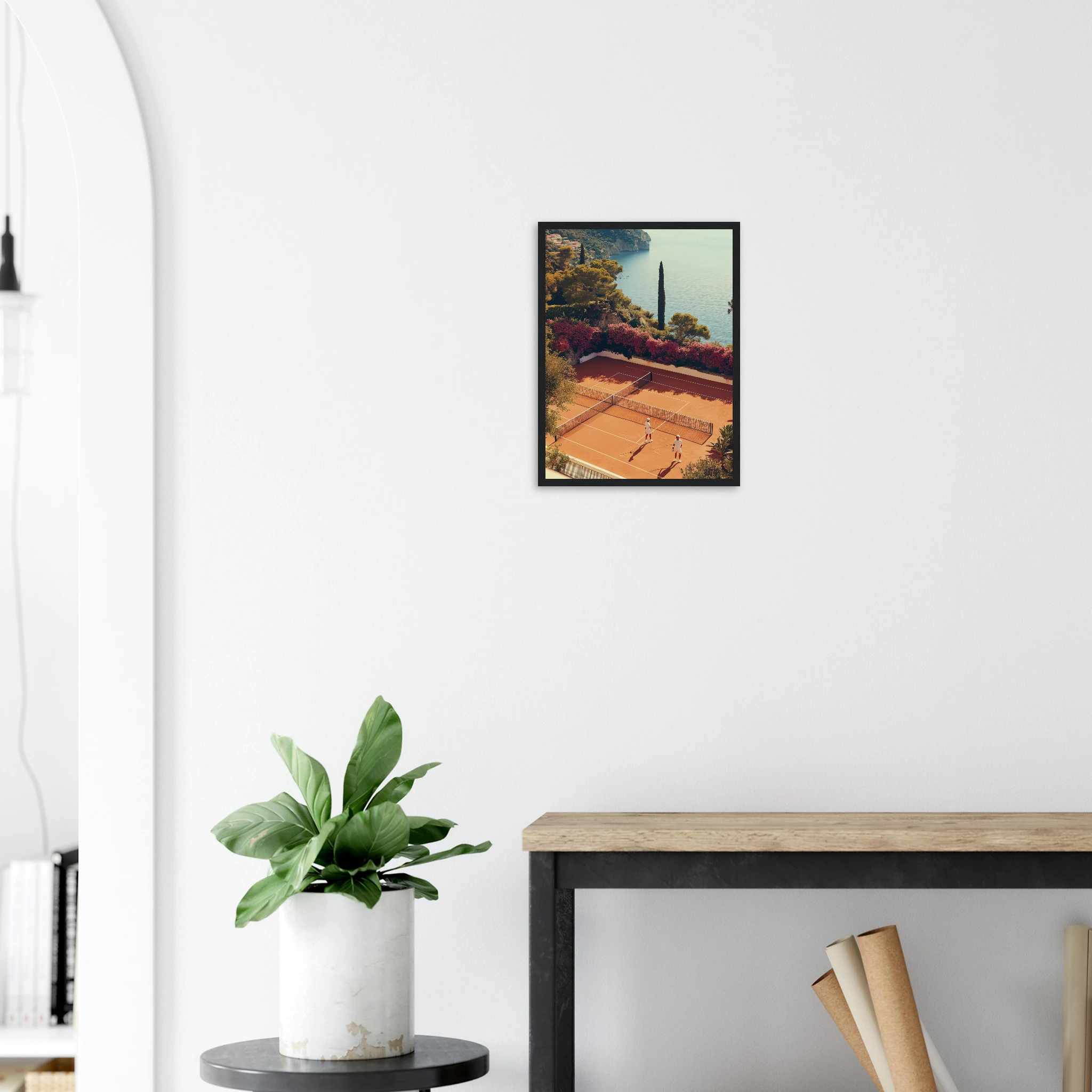
The framing decision for tennis prints follows the same logic as any art photography: let the image lead, and don’t introduce visual noise the composition doesn’t need.
For aerial clay court prints, a thin black frame sharpens the geometric precision of the composition and contrasts cleanly with the terracotta. A natural wood frame — slim oak or walnut — brings warmth that complements the Mediterranean palette. Both work. Heavy or ornate frames compete with the image and should be avoided.
Canvas is an excellent alternative to framed prints for tennis wall art — the gallery-wrap finish gives the image a sculptural presence that suits the aerial, graphic quality of the best court photography. No frame required, and the image wraps around the edges rather than cutting off at the border.
FAQ
Is tennis wall art appropriate for non-sports rooms?
Yes — the best tennis prints don’t read as sports art. Aerial court photography and lifestyle-driven tennis imagery function as interior photography first, sporting subject second. They suit living rooms, studies and hallways as naturally as any landscape or abstract print.
What size should a tennis wall art print be?
For aerial court prints, larger is better. At 50×70cm the geometry begins to open up; at 70×100cm it really works as a statement piece. Smaller than that and the detail and precision of the aerial view loses much of its impact.
Which tennis surface looks best as wall art?
Clay courts. The terracotta palette is the most versatile for residential interiors — warm, Mediterranean, and compatible with a wide range of interior colour schemes. The texture of the clay surface also renders beautifully in fine art printing.
Can tennis wall art work in a bedroom?
Yes, with the right image. An aerial clay court print at golden hour — warm tones, no action, purely geometric and atmospheric — works in a bedroom as well as a landscape or abstract. Avoid high-contrast or action-heavy images in a bedroom context.