
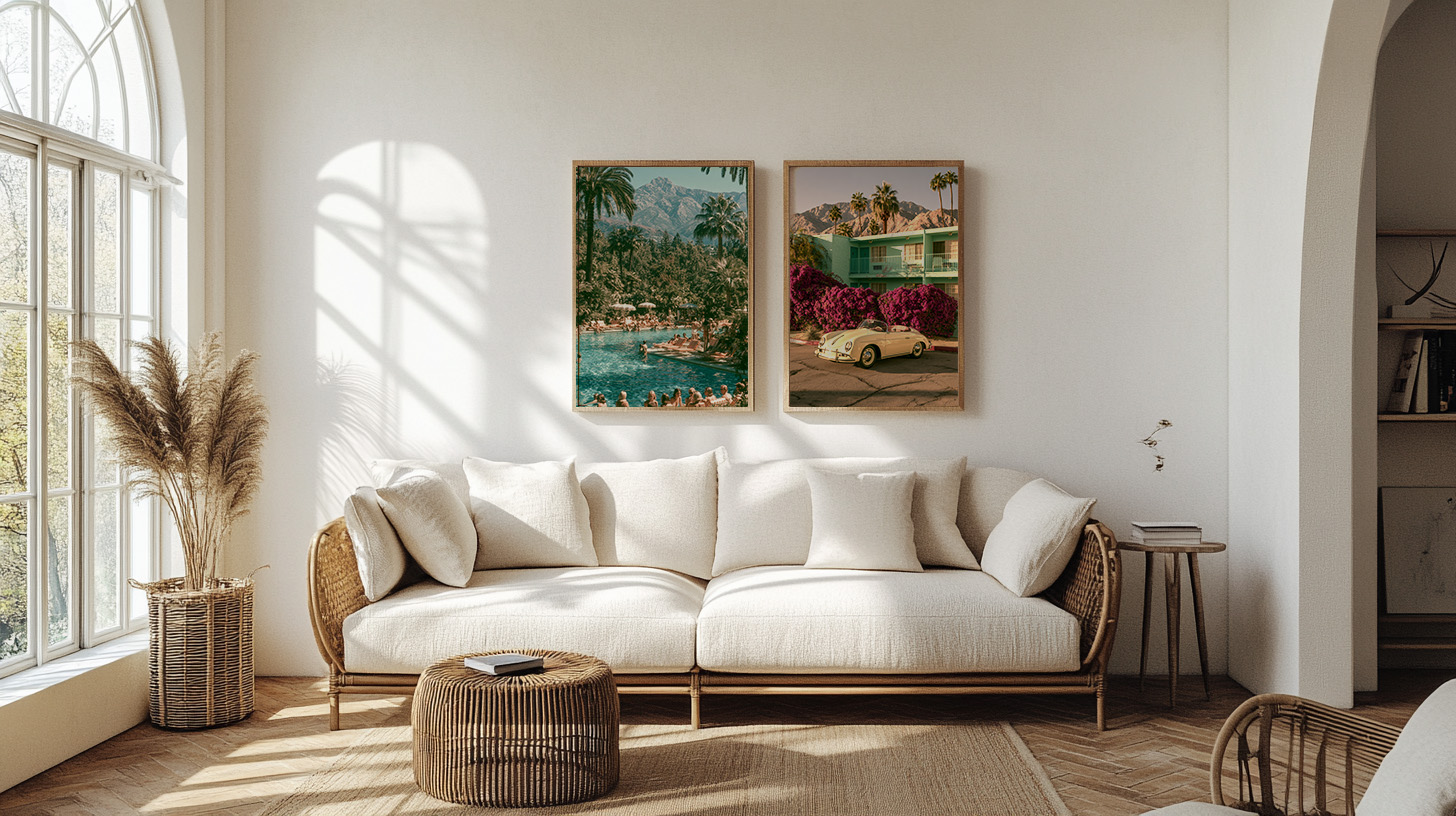
A gallery wall either looks like a considered editorial choice or a jumble of frames that ended up on the same wall. The difference isn’t budget — it’s method. Here are five approaches that actually work.
Start with a visual anchor
Every successful gallery wall has one piece that sets the tone for everything around it. This anchor is typically the largest print in the arrangement — the one you’d keep if you had to take everything else down. Find that piece first, before you decide anything else.
The anchor doesn’t have to be centred on the wall. It can sit left of centre, with smaller pieces extending right. What matters is that it’s clearly dominant — in size, colour weight, or subject. The rest of the gallery wall exists in relation to it.
At Atelier Marbella, a 70×100 cm matte print makes a natural anchor. Its proportion is large enough to hold a wall without overwhelming it, and matte stock photographs cleanly as part of a grouped arrangement.
Plan on the floor before touching the wall
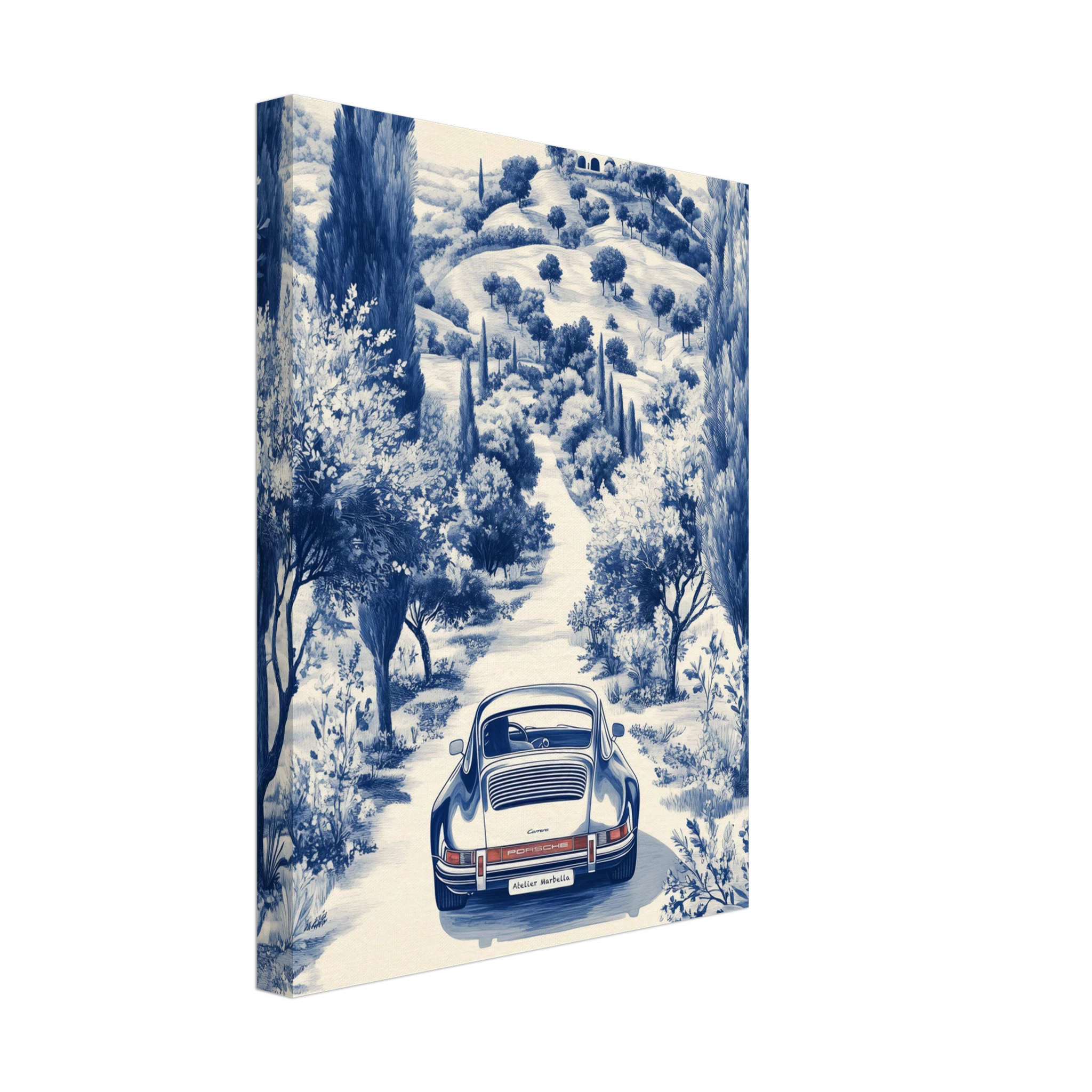
This is the step most people skip — and the reason most gallery walls end up with too many holes and a slightly off-kilter result. Lay every print or frame face-up on the floor in roughly the arrangement you want on the wall.
Photograph it from above. Then study the photo — it shows you the composition more objectively than looking at it on the floor. Adjust spacing, swap positions, remove what feels unnecessary. When the photo looks right, the wall will too.
Use paper templates for hanging: cut paper to the exact size of each frame, tape them to the wall with painter’s tape, and live with the arrangement for a day before committing to any nails.
Commit to a consistent spacing rule
The detail that separates a gallery wall that looks intentional from one that looks accidental is spacing. Consistent gaps — 5 cm, 8 cm, 10 cm, your choice — signal intention. Inconsistent gaps suggest you were working it out as you went.
Prints that work here: the Figs Framed Print, the Eggplants Framed Print and the The Tomatoes – Framed Print Framed Print — each available as a framed print, ready to hang. Browse the Kitchen collection for more.
For a tight, editorial look, aim for 5 to 7 cm between frames. For something airier and more relaxed, 10 to 15 cm. Both work — but commit to one or the other across the whole arrangement.
A laser level, or even a good spirit level app on your phone, is worth the 30 seconds it takes to use. Slightly tilted prints in a gallery wall catch the eye immediately and undermine the whole composition.
Looking for prints that work together? Browse the full collection.
Explore the collection →Mix formats, not styles
The most common mistake in building a gallery wall is mixing too many different visual styles — abstract prints next to photography next to typography next to botanical drawings. The result is visual noise rather than curation.
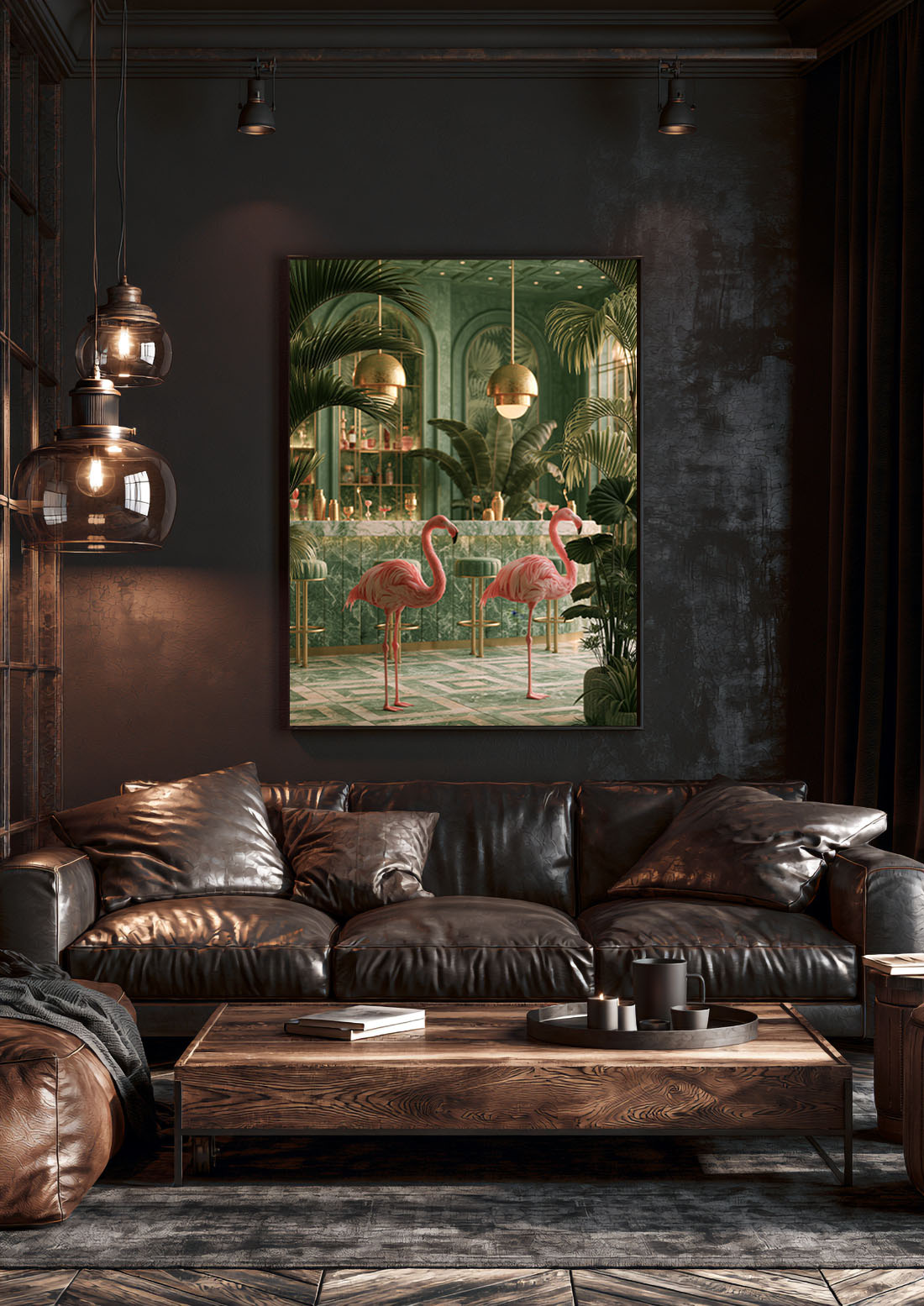
Instead, mix formats within a consistent visual world. Two portrait prints and one square, or a large landscape anchored by three smaller verticals. The subjects can vary — a coastal scene alongside a botanical study alongside an architectural detail — but if they share a tonal palette and a consistent mood, the arrangement reads as a collection, not a coincidence.
Mediterranean prints work particularly well in gallery walls for this reason. The palette is consistent — dusty sage, warm terracotta, bleached stone, deep blue — even when the subjects are different. That shared atmosphere is the thread that holds a gallery wall together.
Know when to stop
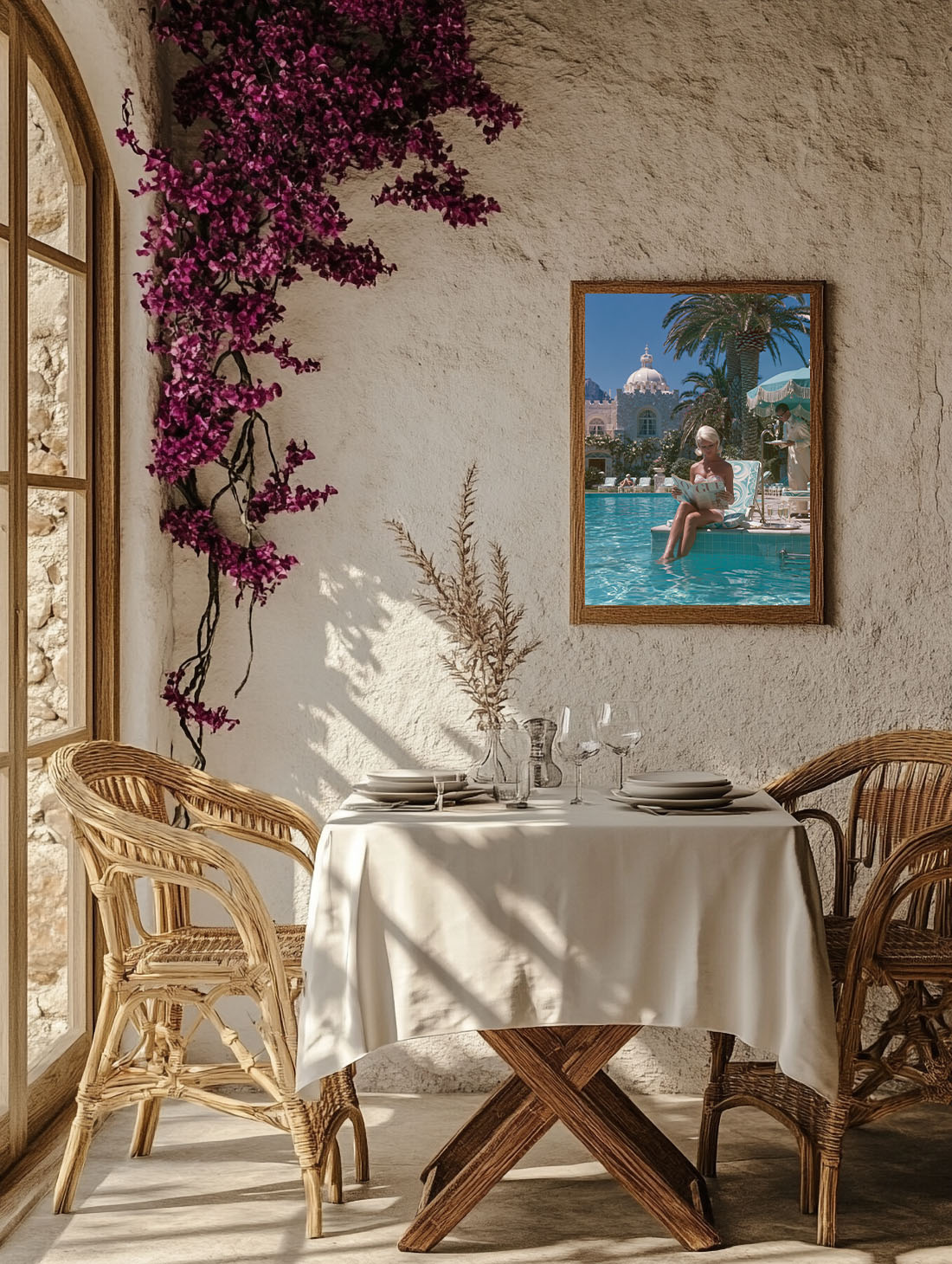
A gallery wall isn’t more successful because it has more pieces. The strongest arrangements often have three to five prints. Beyond seven or eight, the eye has nowhere to land — everything starts competing at the same volume.
If you’re building a gallery wall for the first time, start with three: one anchor and two companions. Live with it for a few weeks. If the wall needs more, you’ll know. If it doesn’t, you’ve already made the right call.
White space around a gallery wall matters as much as the prints themselves. The wall isn’t a background — it’s part of the composition. Let it breathe.
FAQ — gallery wall
How many prints do I need for a gallery wall?
Three is a good starting point. Most well-composed gallery walls have between three and seven pieces. Beyond that, the arrangement can feel crowded — especially in smaller rooms.
Should all frames in a gallery wall match?
Not necessarily. Matching frames create a more formal, unified look. Mixed frames work in more eclectic spaces, as long as you keep one common variable (all black, all wood, all the same width).
What’s the right height to hang a gallery wall?
The visual centre of the arrangement should sit at eye level — around 145 to 150 cm from the floor. For a sofa wall, bring that down slightly to 135 to 140 cm so the art relates to the seated position.
Can a gallery wall work in a small room?
Yes — in fact, a well-composed gallery wall in a small room creates a sense of depth and personality that bare walls can’t. Keep the arrangement tight (5 to 7 cm gaps) and limit it to three to five pieces.
How do I stop a gallery wall from looking chaotic?
Consistent spacing, a shared colour palette across the prints, and one clear anchor piece. Those three things account for 90% of what makes a gallery wall feel curated rather than cluttered.