
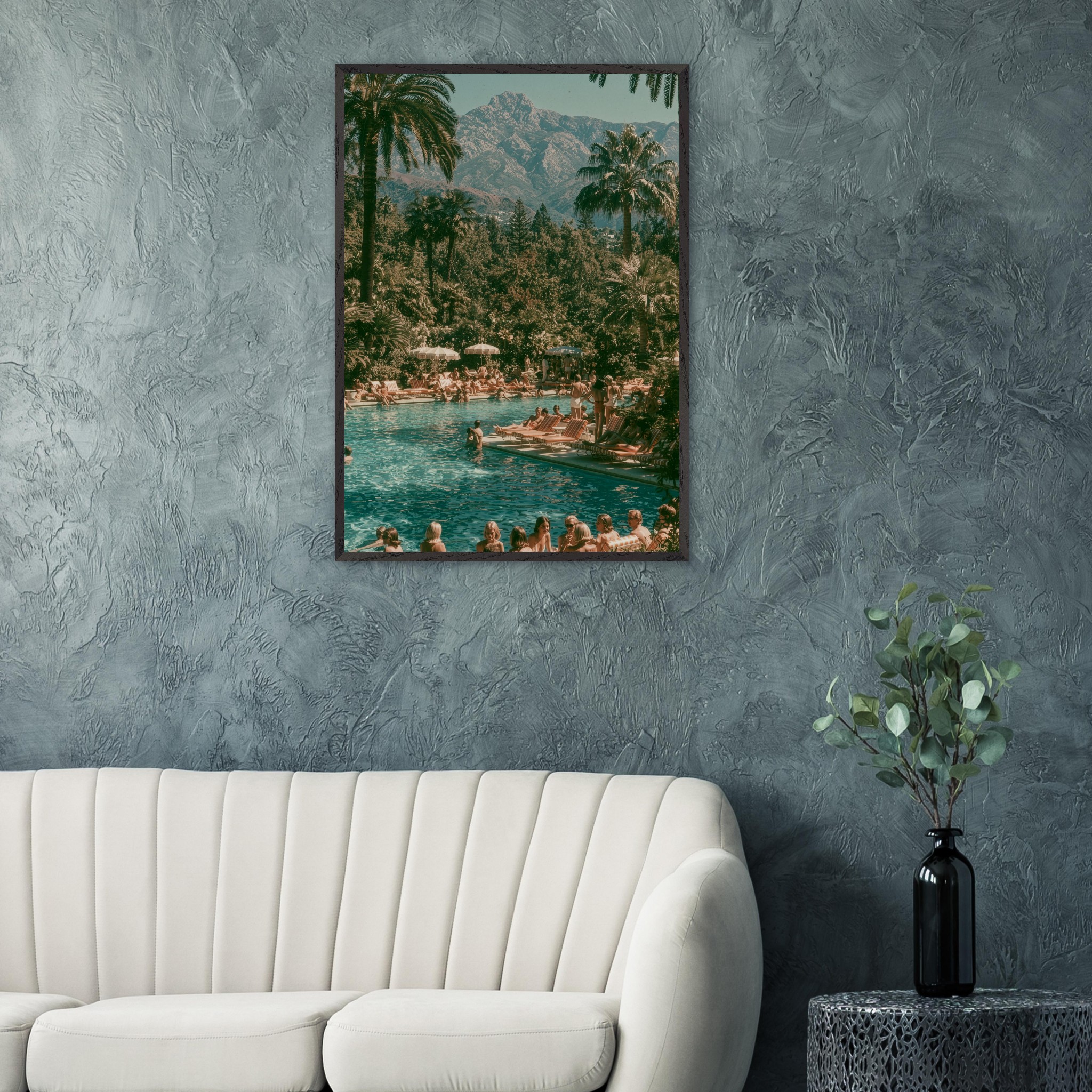
Mediterranean wall art does something that most decorating advice cannot: it creates atmosphere rather than filling space. A single print — a terracotta coastline, a sunlit lemon grove, the blue geometry of a Moroccan tile — can shift the entire register of a room. Not through colour alone, but through what it implies about light, temperature and the way time moves somewhere south of the Alps.
In This Article
- What Mediterranean Wall Art Actually Means
- The Subjects Worth Hanging
- The Mediterranean Palette on a Wall
- How to Place a Mediterranean Print
- Building a Mediterranean Gallery Wall
- FAQ
What Mediterranean Wall Art Actually Means
The word Mediterranean gets stretched across a lot of interiors that have nothing to do with the actual sea. Turquoise accents, a few terracotta pots and some rattan — and a room becomes “Mediterranean” in the language of most décor publications. Real Mediterranean wall art is something more specific and more considered than that.
The Mediterranean aesthetic, at its root, is about a relationship with light. Southern light is not soft: it is direct, high-contrast, bleaching in the middle of the day and extraordinary at the hour before sunset. Mediterranean art prints that capture this quality — the harshness and the beauty together — are the ones that carry genuine atmosphere into a room. A photograph taken at noon on the Costa del Sol, a painting that renders the shadow geometry of a whitewashed village: these are images that know what they’re looking at.
Geography matters too. The Mediterranean is not a single visual culture — it is thirty countries and several thousand years of distinct aesthetics. Spanish, Italian, Greek, North African, French Riviera: each tradition has its own visual language, and a strong print tends to come from one specific place rather than a vague impression of all of them.
The Subjects Worth Hanging
Not every Mediterranean subject translates equally well onto a wall. Some images carry narrative, light and geometry into a room. Others arrive as decoration and stay that way.
Prints that work here: the Aegean Blue Domes Framed Print, the Villa Rosa — Andalusian Pool Framed Print and the Calanque Anchorage Framed Print — each available as a framed print, ready to hang. Browse the Mediterranean Mood collection for more.
Coastline and water are the most powerful Mediterranean subjects when the photography is strong. Not tourist photography — not the generic clifftop overlook — but images that capture the light on water at a specific moment, or the geometry of a harbour at low tide. A great coastal print at large format has the quality of a window rather than a picture.
Architecture — the geometry of white walls, the shadow of an arcade, the repetition of terracotta rooflines — creates a different kind of atmosphere. More structural, more graphic, less about emotion than about the formal beauty of the built environment. This kind of print suits a more minimalist interior, one where the architecture of the room and the architecture in the image can speak to each other.
Botanical subjects — lemon trees, bougainvillea, olive branches, palms — are the Mediterranean’s most commercially successful subjects for good reason: they are beautiful, they reference warmth and abundance, and they pair with almost any interior palette. The risk is genericness. A botanical print earns its place when the composition is strong enough to stand as an image independent of its subject.
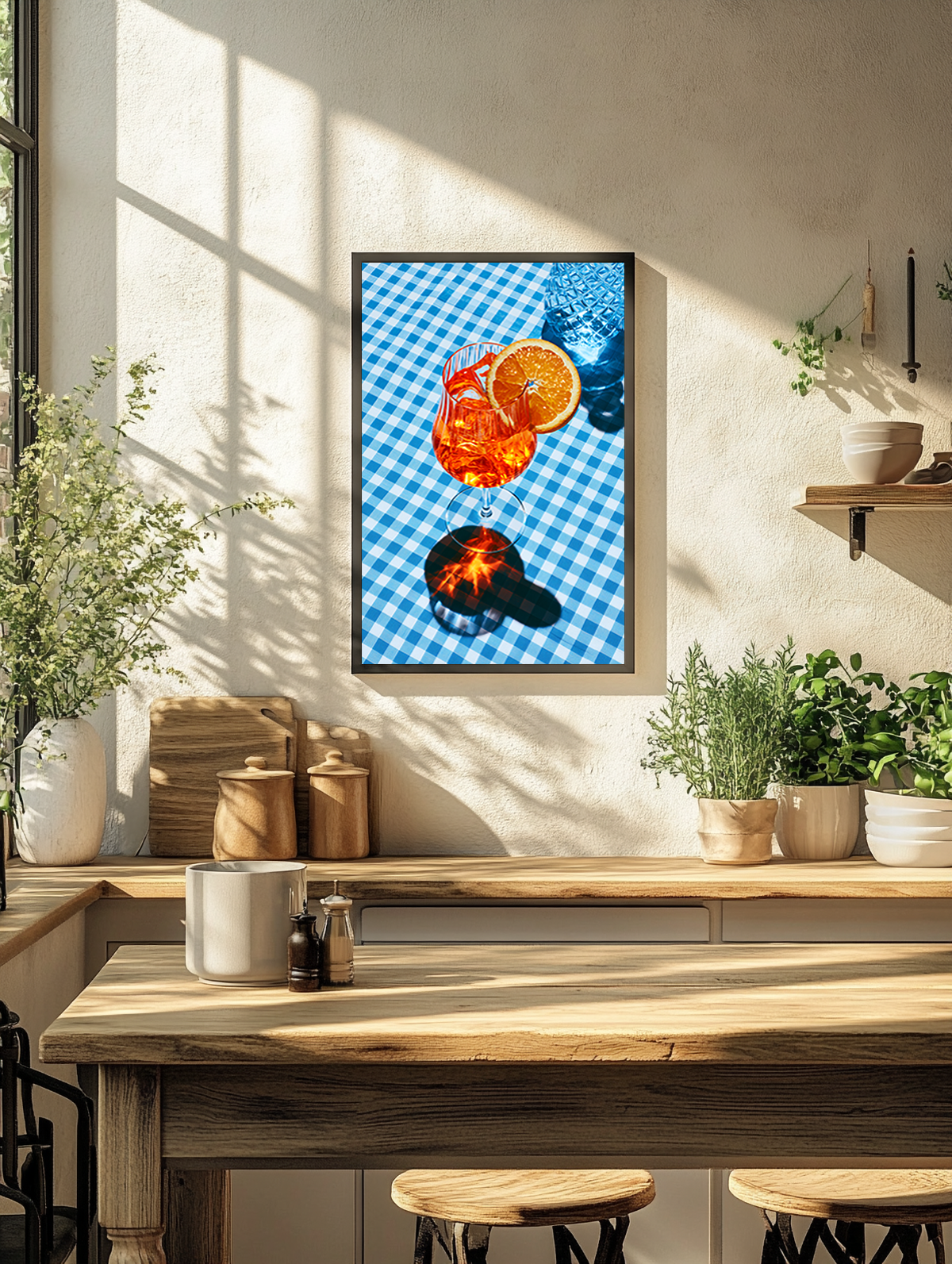
Food and still life — aperitivos, ceramic dishes, market scenes — belong in kitchens and dining rooms, and nowhere else. The subject is too specific to read as anything other than thematic in a living room or bedroom.
The Mediterranean Palette on a Wall
Mediterranean wall art works across a much wider range of interior palettes than most people assume. The instinct is to match — terracotta print with terracotta wall, cobalt blue with a white and blue room — but the more interesting approach is contrast and complement.
A print heavy in warm terracotta and ochre reads completely differently against a deep-toned wall (where it becomes rich and jewel-like) versus a pale one (where it becomes bright and graphic). Neither is wrong, but they are different rooms.
The Mediterranean palette — warm whites, dusty blues, faded ochres, the specific green of olive leaves, the burnt orange of clay — contains colours that age well with both neutral and saturated interiors. Where it tends to struggle is in rooms that are already maximally colourful: the Mediterranean aesthetic is about restraint within abundance, not about adding more.
For black and white Mediterranean prints, the power is in the light. The best monochrome coastal or architectural images have the tonal range of classical photography — deep shadows, brilliant highlights — and age with extraordinary grace. They suit both contemporary interiors and more traditional ones without adjustment.
How to Place a Mediterranean Print
A Mediterranean print placed above a sofa, at eye level from a seated position, functions as a horizon — it creates depth and draws the eye through the room. This placement works particularly well with coastal and landscape images, where the horizontal format mirrors the way we actually look at a landscape.
For architectural or botanical subjects in portrait format, the key is height. The centre of the print should sit at approximately 145–150 cm from the floor — standard gallery height — and the print should have enough wall around it to breathe. Mediterranean art is about space and light; crowding it defeats the purpose.
One placement that consistently works: a large Mediterranean print in a room with direct natural light, positioned on a wall the light does not directly hit. The contrast between the lit room and the lit image — especially if the print is of a sun-heavy scene — creates a layered quality that photographs never quite capture but is immediately felt when you enter the space.
Building a Mediterranean Gallery Wall
A Mediterranean gallery wall works differently from a trend-driven one. The temptation is to group every Mediterranean subject together — boats, lemons, tiles, coastal cliffs — and the result tends to look like a mood board rather than a considered collection.
The more effective approach is to choose a consistent quality: all photographs, or all prints with a warm tonal palette, or all images that share a compositional logic (horizontal lines, geometric subjects, a consistent relationship between light and shadow). The Mediterranean becomes the thread rather than the category.
Scale matters more here than in any other gallery wall configuration. One large anchor print — 80×100 cm or above — with two or three smaller supporting works creates a structure that has visual authority. An arrangement of same-sized prints looks catalogued. The Mediterranean at its best is neither symmetrical nor chaotic: it is composed.
Atelier Marbella · Mediterranean Wall Art
Premium Matte & Framed Prints — Marbella, Spain
Shop Mediterranean Prints →What Defines Mediterranean Wall Art
The category is broader than it first appears. Mediterranean wall art is less about a single subject and more about a quality of light and mood. You will find it in prints of lemon groves and terracotta rooftops, in vintage car scenes set against Riviera backdrops, in still lifes of aperitivo tables caught in golden afternoon shade.
What these images share is restraint. The palette tends toward warm neutrals, bleached stone, deep terracotta, and the particular blue-green of Aegean water. The compositions are unhurried — there is space to breathe. Nothing competes for attention in the way of mass-market prints.
This is what separates genuine Mediterranean wall art from the generic coastal prints that saturate the market: atmosphere over subject matter. A print that happens to show a boat is not Mediterranean art. A print that makes you feel the heat of a stone terrace at noon — that is something else entirely.
The Palette That Actually Works
Mediterranean interiors are built on a specific range: bone white, raw linen, warm stone, dusty olive, muted terracotta, deep navy. The wall art that works best in these spaces is calibrated to the same register.
A print too saturated — too turquoise, too aggressively warm — breaks the spell. What you want is the sense that the image has been bleached slightly by years of southern sun. Natural tones, soft gradients, colours that sit comfortably alongside raw plaster or stone flooring.
If your interior leans warm (terracotta, walnut, amber linen), look for prints with similar undertones: a Marbella courtyard scene, a Riviera hillside, a still life with wine and ripe fruit. If your space is cooler (white plaster, grey stone, linen), lean into sea-facing blues and greens — a Calanque bay, a harbour at dusk. The goal is not to match colours precisely, but to ensure the print belongs in the same world as the room.
Which Rooms Benefit Most
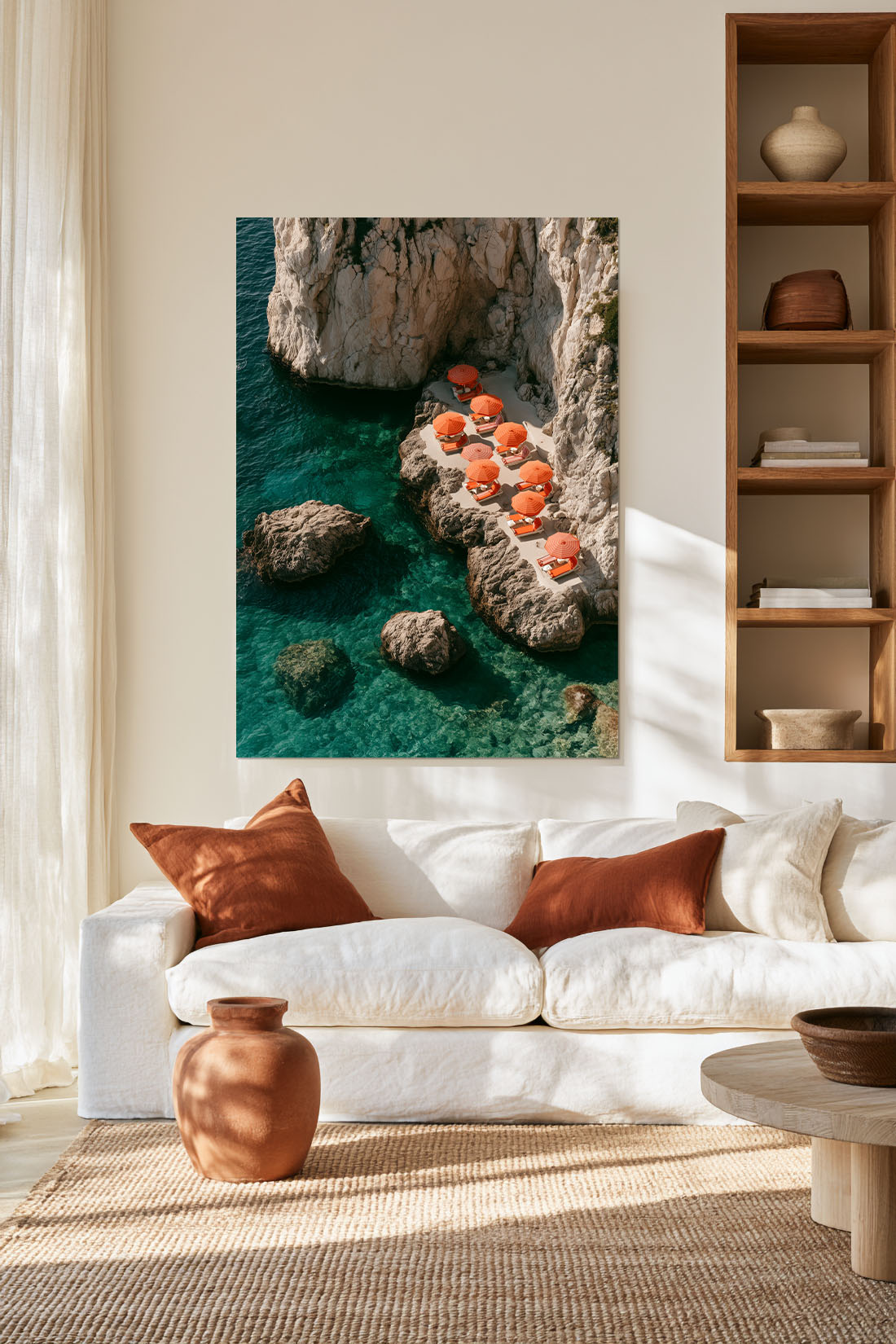
Living room. Large format is almost always the right choice here. A single oversized Mediterranean print — a coastal landscape, a terrace scene — can anchor an entire interior more effectively than a gallery wall of smaller pieces. Give it a wall of its own. Let it breathe.
Dining room. Food, wine, warmth — the Mediterranean table translates naturally into a dining space. Italian kitchen still lifes, prints of aperitivo spreads, a slow coastal scene at dusk: all carry the right association. The dining room is where atmosphere matters most, and this kind of art delivers it without effort.
Bedroom. The bedroom benefits from restraint. A single well-chosen print above the bed — calm over dramatic, atmospheric over illustrative — is enough. The key is prints that belong to the same register as white linen and morning light.
Hallway. Often overlooked, but the hallway is where first impressions are made. A bold Mediterranean print here — architectural, graphic, confident — sets the tone for everything that follows. If there is only one room in your home to commit to art, the hallway has the highest return.
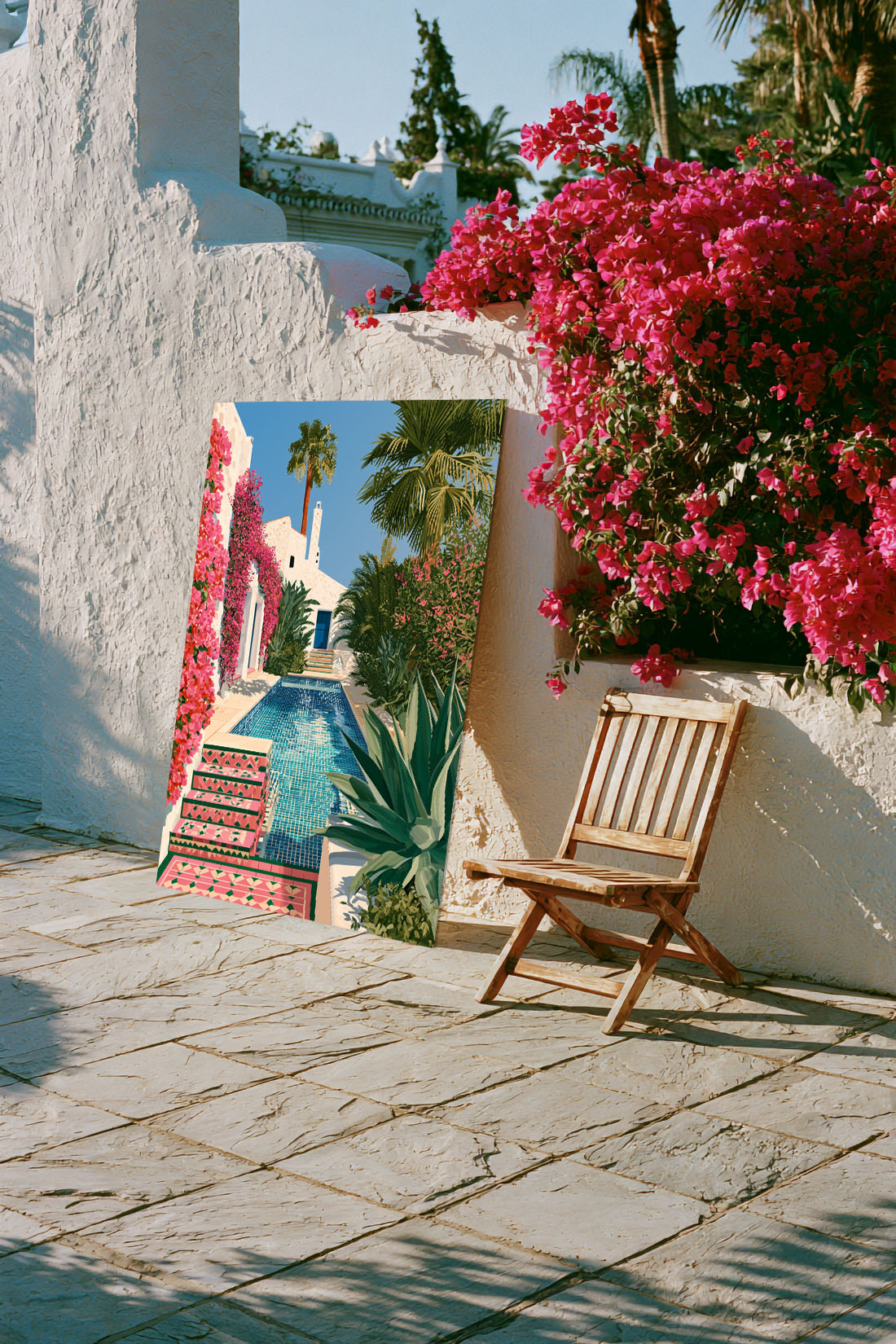
Large Format or Gallery Wall?
Both approaches work, but they serve different rooms and different intentions.
A single large-format print (50×70cm or larger) carries authority. It reads as a deliberate choice rather than an assembly. It demands nothing from surrounding objects and tends to perform best in more minimal interiors. If you have the wall and the right piece, this is the higher-risk, higher-reward option — and usually the one that ages best.
A gallery wall built from Mediterranean prints allows more narrative. A Marbella scene alongside a Riviera car print alongside a citrus still life creates a world, not just an image. The key is coherence: the prints should share a palette or a point of view, even if their subjects differ entirely. Mix sizes — anchor with a large central piece, support with smaller formats — and leave breathing room between frames.
Framing and Finish: What the Right Choice Looks Like
Frame choice is part of the work. For a Mediterranean interior, natural wood frames — light oak, unfinished pine — are the most versatile. They read warm without being heavy. Black frames work in more graphic, high-contrast compositions. White frames have become ubiquitous and tend to disappear rather than complement.
Matte finishes suit the Mediterranean aesthetic better than glossy. A matte art print has the quality of something handled — a postcard, a page from a coffee table book. It sits in a room without competing with it. Canvas offers a different texture: more tactile, slightly warmer, better suited to large-format landscape work. If you are hanging art in a room with significant natural light, matte or canvas will always outperform a gloss surface, which introduces reflections that work against the image.
How to Choose a Piece That Actually Lasts
The prints that carry genuine Mediterranean atmosphere are not the ones you find in a mass catalogue. They come from original artwork — imagery with an edit, a point of view, a reason to exist. Ask yourself whether the image would still feel right in ten years. Mediterranean wall art done well is not seasonal. It does not reference a trend. It captures something true about the light, the culture, the pace of life south of the 40th parallel.
Look for work that has been made with intention. A print of the Côte d’Azur that was photographed from a specific vantage point at a specific hour will always outlast a generic stock-photo interpretation of the same view. The difference is legible in the image itself — in the way the light lands, in what has been left out of the frame.
Explore the full Mediterranean wall art collection at Atelier Marbella — original artworks available in matte print, canvas, and framed finish. Each piece is printed on archival materials and ships worldwide.
Read Also
Living Room Wall Art: The Statement Piece That Anchors a Room
Dining Room Wall Art: The One Print That Makes a Room
What makes Mediterranean wall art different
Mediterranean art is defined by a quality of light you don’t find anywhere else — the kind that turns white walls gold at midday and makes the sea look almost unreal. When you bring that into a room, you’re not decorating. You’re setting a mood.
The best mediterranean wall art prints work across interior styles — as naturally in a clean Scandinavian apartment as in a warm, textured southern European home. The common thread isn’t the subject: it’s the feeling of calm and clarity they carry.
At Atelier Marbella, every print is made to hold that feeling. Whether it’s a coastal scene from the Costa del Sol or a botanical study from the Algarve, the atmosphere is always the same: sun, stillness, and a slight sense of elsewhere.
How to choose the right size for your wall
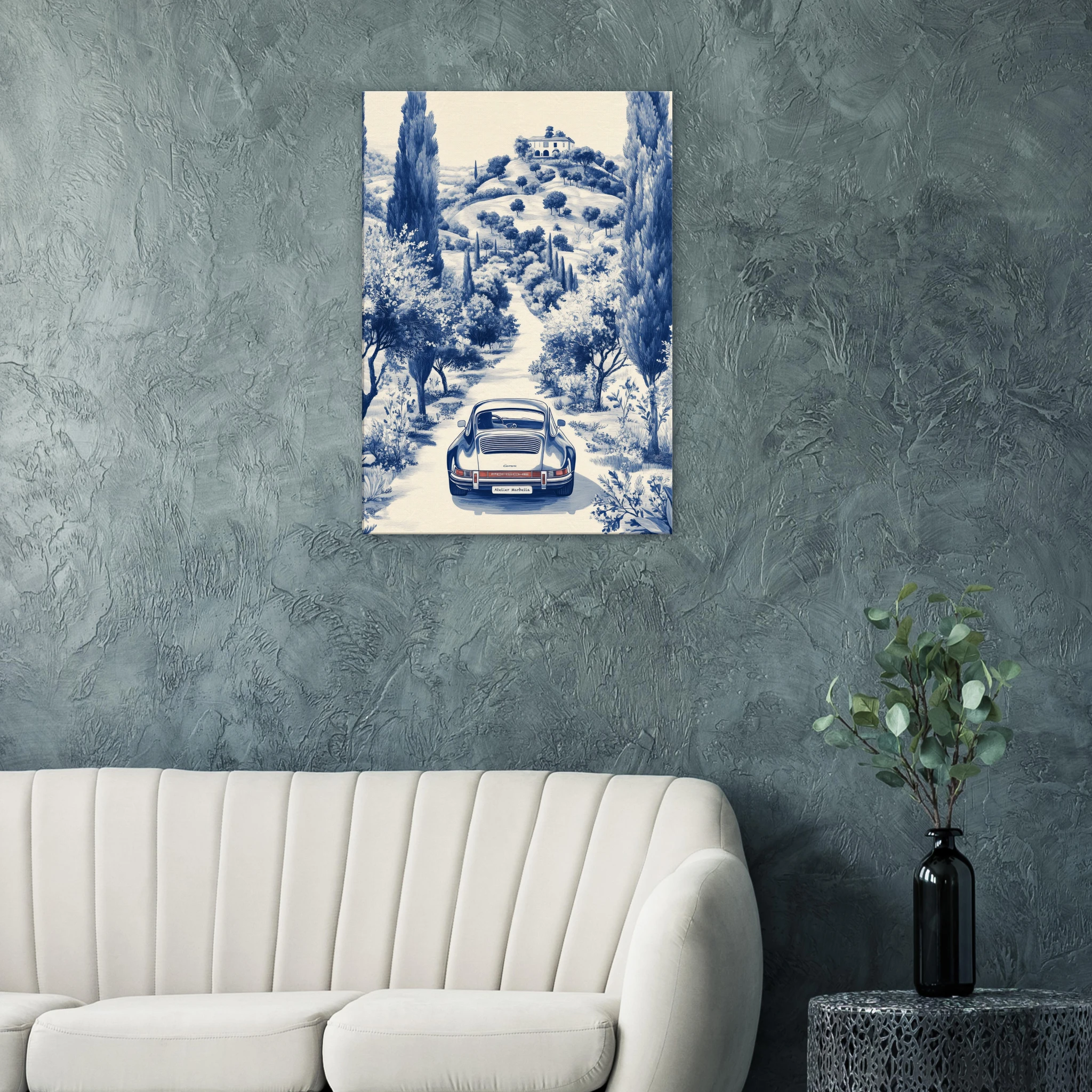
Scale is the most underestimated decision in wall art. A print that’s too small on a large wall looks like an afterthought. Too big, and it overwhelms everything else. The rule: your artwork should fill between 60% and 75% of the available wall space.
For a sofa wall — typically 180 to 220 cm wide — a single 60×90 cm or 70×100 cm print works well. If you prefer a pair, two 50×70 cm prints with 5 to 10 cm between them give a balanced, editorial feel.
Above a bed, aim for a width that matches or slightly exceeds the headboard. That single proportion change makes the whole room feel more intentional.
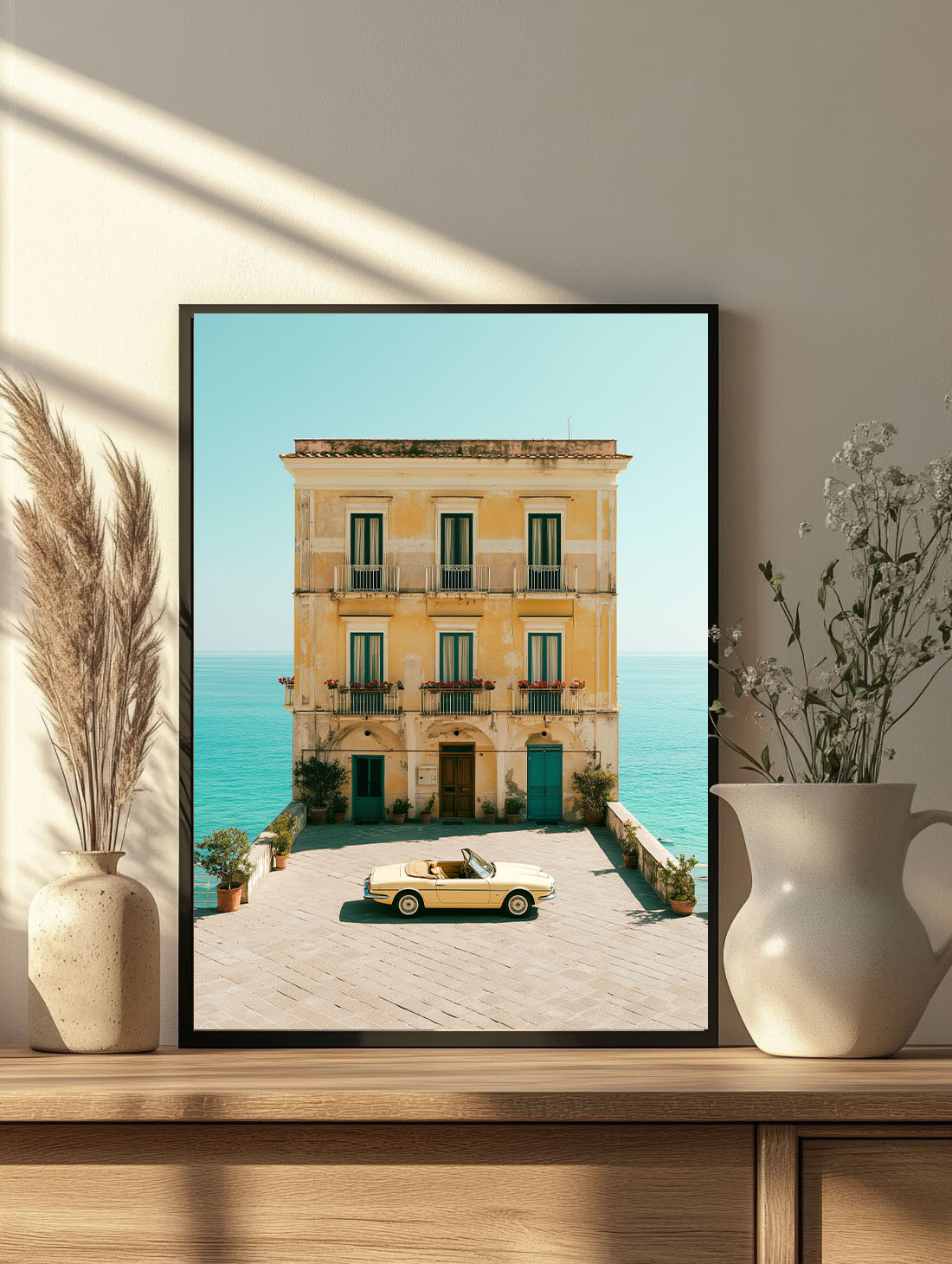
Matching your mediterranean art to your colour palette
Mediterranean prints carry a natural palette: dusty sage, warm terracotta, bleached linen, deep cobalt, soft ochre. These tones don’t impose — they integrate. The trick is to find one colour in the print that already exists somewhere in your room.
It doesn’t have to be a perfect match. A terracotta note in a print connecting to a warm wood floor is more than enough. That single link makes the whole composition feel considered rather than coincidental.
In very neutral rooms (whites, greys, natural linen), a bolder mediterranean wall art print becomes the focal point — and that’s exactly where it belongs.
Ready to find a print that belongs in your space?
Explore the collection →Matte, canvas or framed — which finish suits you
The finish of a print changes how it reads in a room as much as the image itself. A matte art print has a quiet authority: no glare, no reflection, just pure image. It’s the most versatile finish and works under any lighting condition.
Canvas brings a more painterly, textural quality — warmer and slightly more casual. It suits eclectic interiors and living rooms where you want the print to feel lived-in rather than gallery-sharp.
A framed print adds formality and weight. It anchors a wall and works particularly well in entryways, studies, and above a fireplace. At Atelier Marbella, you choose the finish for every design — if in doubt, start with matte.
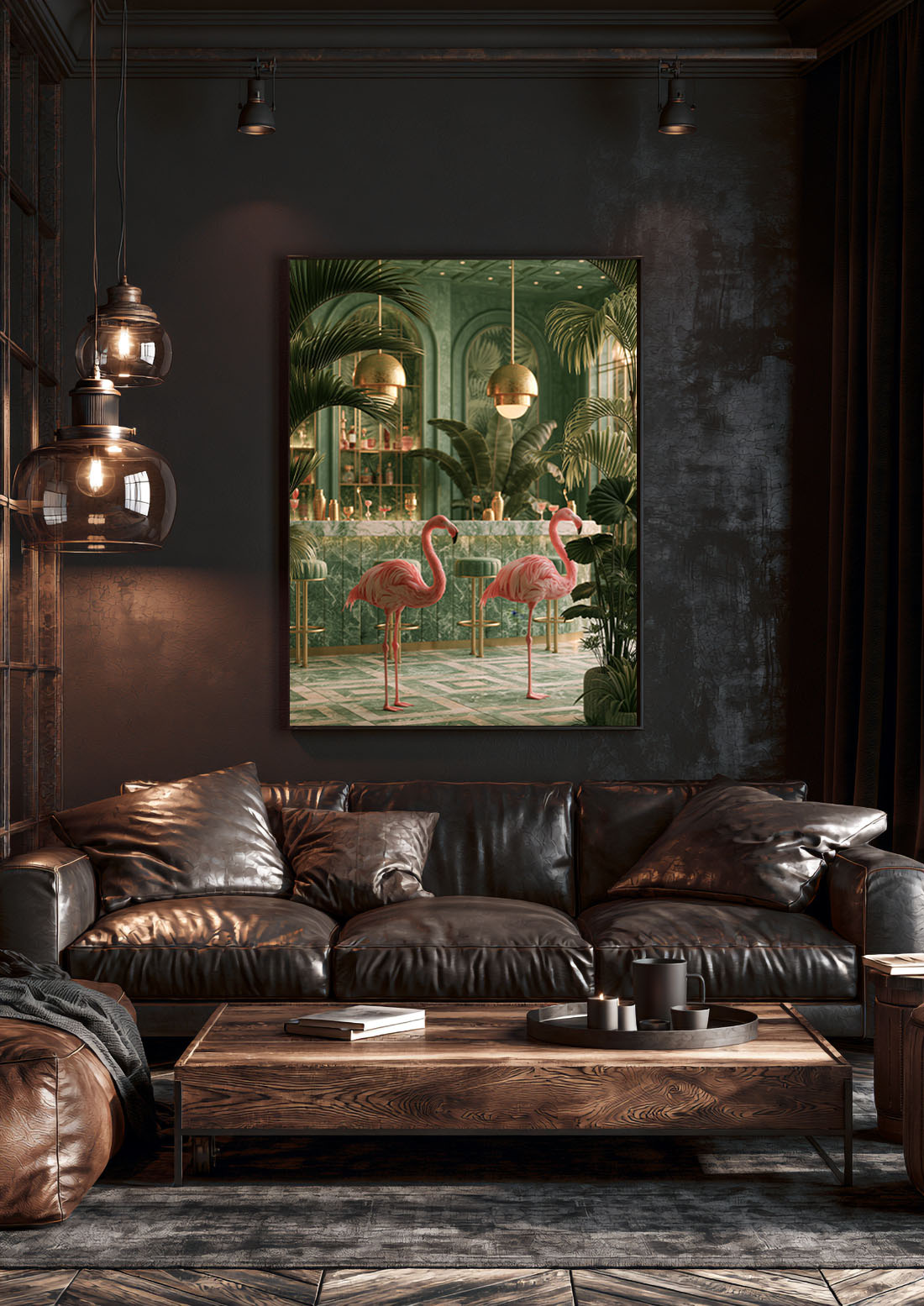
Where to hang your wall art
The centre of a print should sit at eye level — roughly 145 to 150 cm from the floor. In rooms where you’re usually seated (living room, dining room), bring that down to 135 to 140 cm. The art should meet your gaze, not hover above it.
Leave breathing room around the piece. A print that touches shelving or door frames loses its visual impact. Aim for at least 20 cm of clear wall on each side.
For groupings, arrange everything on the floor first. Photograph it, then transfer to the wall. It saves holes — and a lot of frustration.
FAQ — Mediterranean Wall Art
What makes a wall art print genuinely Mediterranean?
Specificity and light. The prints that carry authentic Mediterranean atmosphere are those made in a specific place, at a specific time of day, with an understanding of what makes that light and that geography distinct. Avoid prints that feel generic — the unnamed harbour, the decorative lemon print with no real sense of place. The more specific the image, the more atmosphere it carries.
What size Mediterranean print works best for a living room?
For a statement piece above a sofa or fireplace, 100×70 cm is the starting point. For a genuine large-format statement — a coastal panorama, a wide architectural image — 120×80 cm or 150×100 cm gives the print the presence it deserves. The Mediterranean aesthetic scales well; large prints carry more of the atmosphere than small ones.
Can Mediterranean wall art work in a minimalist interior?
Yes — and often better than in a maximally decorated one. A single strong print in a spare room carries enormous weight. The key is choosing an image with compositional restraint: geometric architecture, a clean horizon line, a botanical subject with space around it. The print does the work; the room gives it room to work.
What’s the best print finish for Mediterranean subjects?
Matte for photography, where the elimination of reflections lets the detail and tonal range of the image read clearly. Canvas for more painterly or botanical compositions, where the texture adds warmth and suits the organic quality of the subject. Both work; the choice depends more on the specific image than on any rule about Mediterranean art.