
Choosing the wrong art print size is the most common — and most fixable — mistake in interior design. A print that’s too small disappears on the wall. A print that’s too large can overwhelm a space that hasn’t been designed to hold it. But the right size, in the right position, changes a room permanently.
This guide covers how to think about print sizes for every room and wall type — with specific measurements, practical rules, and the reasoning behind them. No guesswork, no vague advice about “trusting your instincts.”
The Standard Art Print Sizes
Art prints typically come in a standard range of sizes. Understanding what each size actually looks like on a wall — not just as a number — is the first step to choosing correctly.
30×40cm — Small. Works as a bedside piece, on a narrow shelf, or as part of a tightly composed gallery wall. On its own on a wall above 1.5m wide, it will look lost. Don’t hang a 30×40cm print where it has to carry a wall by itself.
40×50cm / 40×60cm — Medium-small. Works well in bathrooms, above a desk, or as a secondary element in a gallery wall. Beginning to work as a standalone piece in smaller rooms. Still needs companions on larger walls.
50×70cm — The most versatile size. Works as a standalone piece in bedrooms, studies and hallways. Holds its own on a wall up to about 2m wide. The minimum for a statement piece in most living rooms. When in doubt about whether to go to 50×70cm or 70×100cm, go to 70×100cm.
70×100cm — Large. This is where prints begin to truly command a space. The standard for living room and dining room statement pieces. Works on walls up to 3m wide as a solo piece. Pairs well with furniture at this scale — a sofa, a large bed, a dining table.
100×140cm and above — Statement scale. For rooms with high ceilings, large walls, or interior design that uses scale deliberately. A 100×140cm print on a white wall is an installation, not decoration. Requires confident space and confident art.
Room-by-Room Size Guide
Living Room
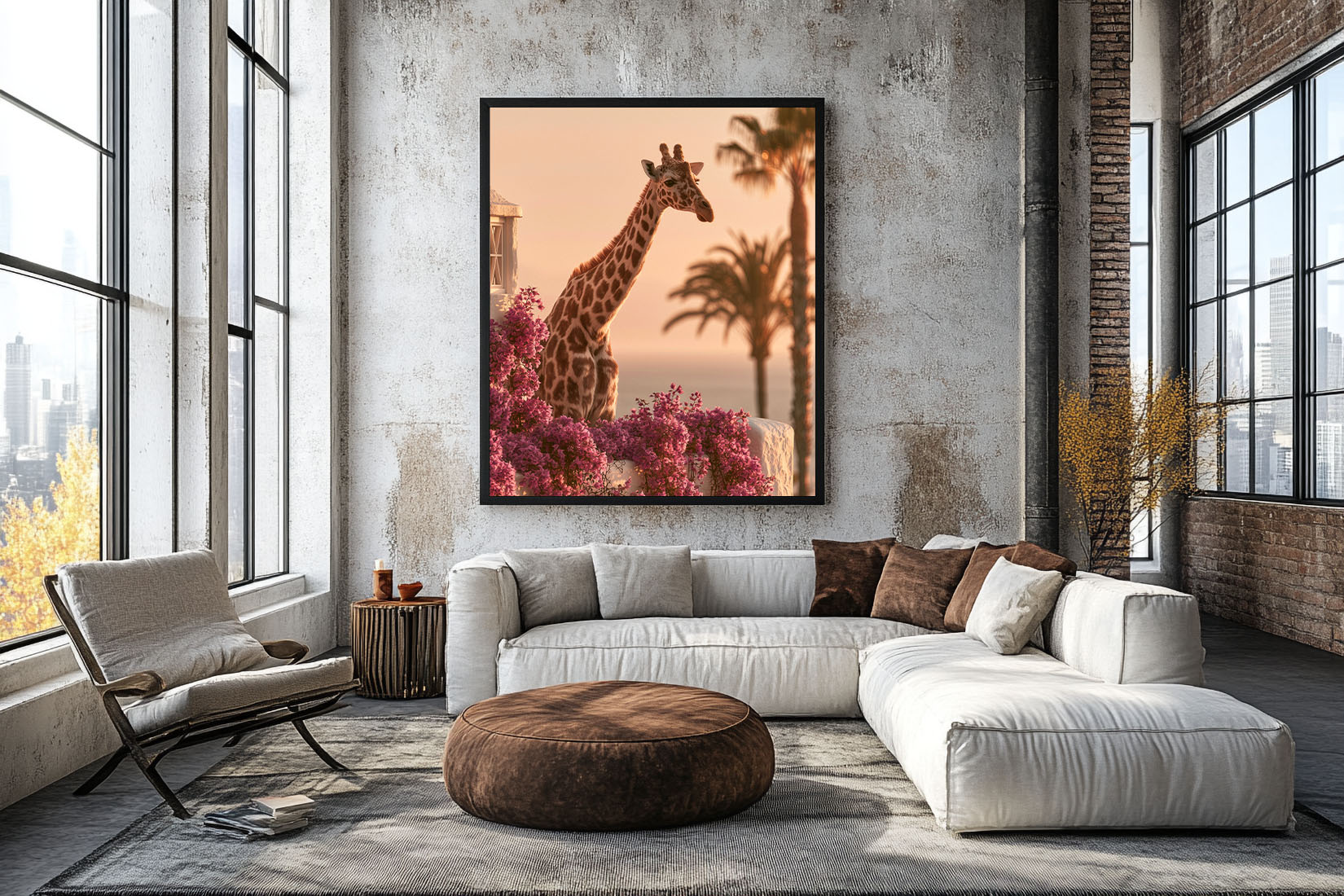
The living room is where most people undersize. A 50×70cm print on a wall above a 2m sofa looks like a postage stamp. The rule for living rooms: your print should be approximately 60–75% of the width of the furniture beneath it. Above a 2m sofa, that means 120–150cm of print width — either a single large print (70×100cm in portrait, or 100×70cm in landscape) or two prints hung as a pair.
Bedroom
Above the bed is the most important wall in the bedroom. A king bed is typically 160–180cm wide — which means the print or arrangement above it should be 100–130cm wide. A single 70×100cm print works, but ideally wider: two 50×70cm prints hung as a diptych, or one horizontal print at 100×70cm.
Dining Room
The dining room is experienced from a seated position, which changes the calculus. A 70×100cm print is the minimum for a statement piece. The wall at the head of the table — the wall guests face as they sit down — needs a print large enough to register across the table. When in doubt, go to 100×140cm.
Hallway
Hallways are encountered at close range and in motion — which means prints that reward detail and have strong immediate visual impact work better than large abstract pieces that need distance to read. In a standard hallway (90–120cm wide), a 50×70cm or 40×60cm print in portrait orientation is the strongest choice. In a wider entrance hall, go to 70×100cm or consider a gallery arrangement on one wall.
See our guide to hallway wall art for specific placement advice.
Bathroom
Bathrooms favour smaller prints — 30×40cm or 40×50cm — partly because of the available wall space and partly because the humidity makes large-format unframed prints a risk. A single framed print at 30×40cm above the toilet, or a pair of 20×30cm prints above the sink, is the standard approach. Go for matte-finish prints in framed format to protect against moisture.
The Measurement Method
Before ordering, do this: cut a piece of paper or card to the exact dimensions of the print you’re considering. Tape it to the wall in the exact position where the print will hang. Live with it for 24 hours. Look at it from across the room. Look at it from the doorway. Look at it from the furniture. Almost everyone who does this ends up ordering a larger size than they originally planned.
Prints that work here: the Aerial Infinity Pool and Sunbeds Framed Print, the Porsche & Leopard Framed Print and the Figs Framed Print — each available as a framed print, ready to hang. Browse the full collection for more.
The paper test consistently reveals the gap between how a size sounds and how it looks. 70×100cm sounds large. On a 3m wall, it looks medium. Do the test.
Portrait vs. Landscape Orientation
Orientation is as important as size. Portrait prints (taller than wide) draw the eye upward and suit rooms with high ceilings — they emphasise verticality and make ceilings feel higher. Landscape prints (wider than tall) ground a space and suit rooms where the horizontal is dominant: long walls, low ceilings, wide furniture.
Square prints are the most flexible — they read as neither portrait nor landscape and suit almost any position. They’re particularly effective in symmetrical arrangements and as standalone pieces above square or cubic furniture.
Matte Print vs. Canvas: Does the Format Change the Size?
The format — matte print vs. canvas — affects how a size reads on a wall. Canvas prints have a three-dimensional presence that matte prints don’t: the gallery-wrap edges add visual weight and make a canvas feel larger than a matte print at the same nominal size. If you’re working with a smaller size than you’d ideally want, canvas is the better choice — it compensates with presence.
Browse the canvas prints, matte art prints and framed prints — all prints available in multiple sizes, matte, canvas and framed.
The 2/3 Rule: Where to Start
Every wall has a visual weight capacity. Exceed it and the room feels crowded. Fall short and the art floats, unanchored.
The clearest way to calibrate this is the 2/3 rule: your artwork should cover approximately two-thirds of the visual width of the surface it anchors.
Above a sofa that’s 200 cm wide, you want artwork — or a gallery arrangement — that spans roughly 130–140 cm. A single 50×70 cm print centered above a full sofa reads as forgotten. A 70×100 cm piece, or a three-print arrangement totalling the right width, reads as intentional.
The same logic applies above a bed, a console, a fireplace. Two-thirds is not a rigid number — it’s a starting point that trains your eye.
How to Measure Before You Buy
Before choosing a size, spend five minutes with a tape measure and a pencil. It saves every mistake.
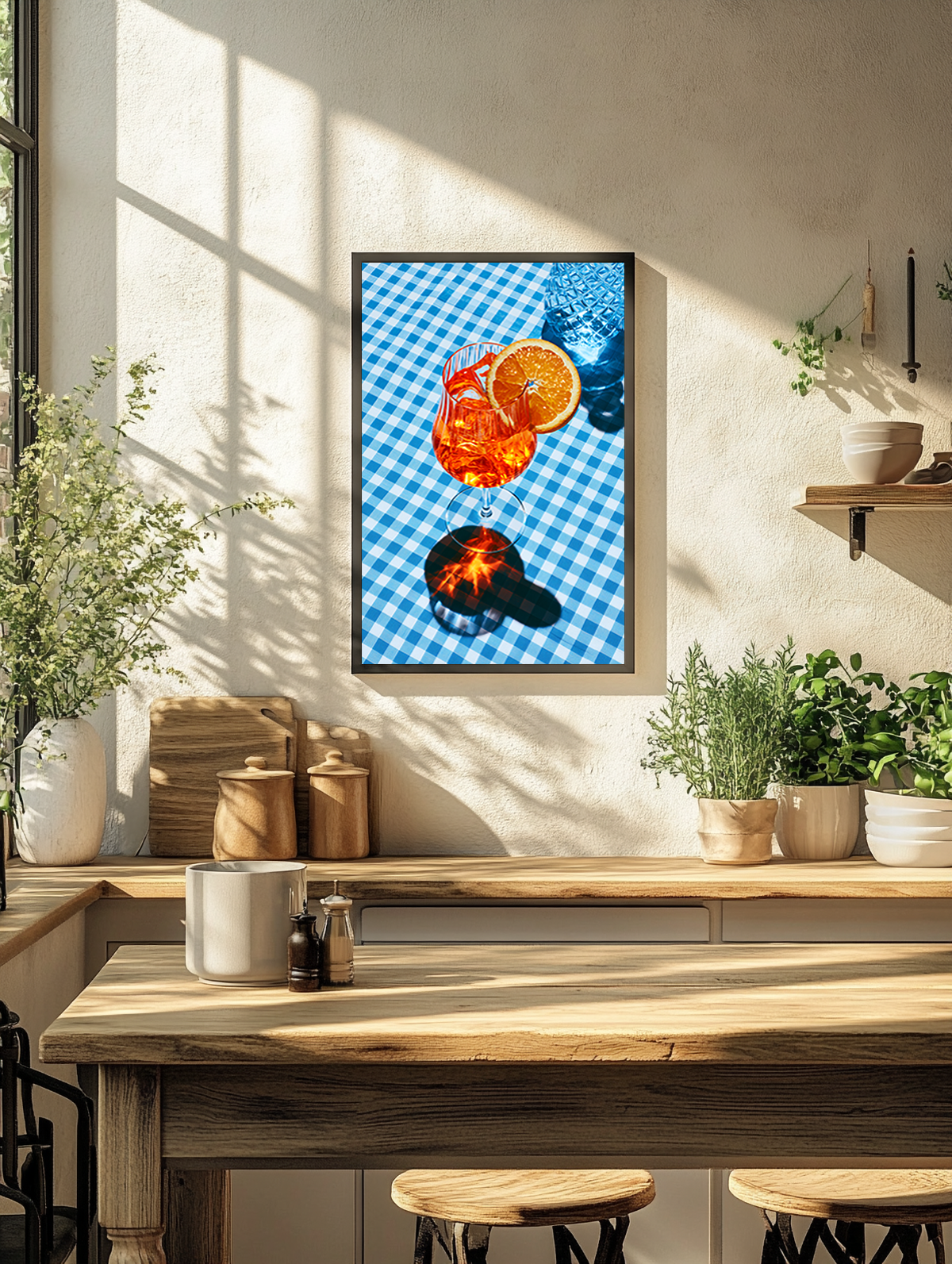
Mark the space. Use painter’s tape to outline the dimensions of the artwork you’re considering directly on the wall. Step back. Live with it for a day. The tape trick is not precious — it’s practical, and it works every time.
Account for furniture. Artwork that hovers too high above a sofa or bed looks disconnected. The standard gap between furniture and the bottom of the frame is 15–20 cm. More than that and the print seems to float. Less and it crowds the piece below it.
Consider the full wall, not just the furniture. If the wall is 280 cm high and the sofa is 90 cm tall, you have roughly 170 cm of vertical space above the sofa. A 100 cm tall print with a 20 cm gap sits at 110 cm off the ground — the centre of the print lands at 160 cm, which is close to eye level. That’s where you want it.
Art Print Size by Room
Living Room
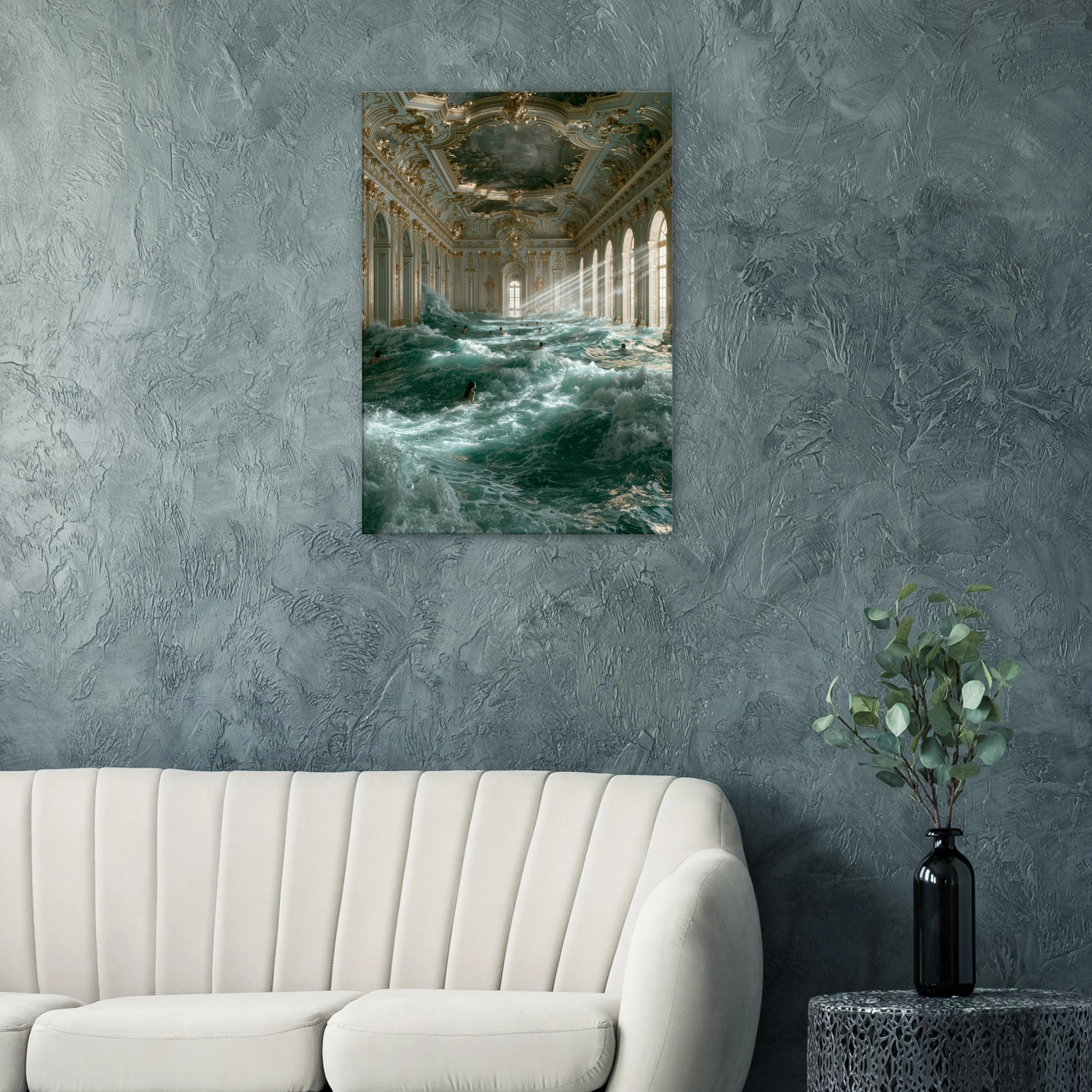
The living room asks for presence. This is where you spend the most time, where guests first form an impression, and where a statement piece earns its place.
Above a sofa: 60×80 cm minimum for a single print. 70×100 cm if the sofa is wide or the wall is generous. For a gallery arrangement, aim for a total visual width of 130–160 cm.
Standalone feature wall: Go large. A 70×100 cm print on an otherwise empty wall feels exactly right. Anything smaller risks looking decorative rather than considered.
→ Explore the Mediterranean Wall Art collection — designed for rooms that take scale seriously.
Bedroom
The bedroom is more intimate. Art here should feel curated, not overwhelming.
Above the bed: Two-thirds of the bed width is your anchor. For a standard 160 cm double bed, that means artwork spanning roughly 100–110 cm — either a single large format or a two-print arrangement. For a king bed (180 cm+), a 70×100 cm print centred above the headboard works cleanly.
Bedside wall: This is where smaller formats shine. A 30×40 cm or 40×50 cm print beside the bed, at lamp height, adds personality without competing with the main piece.
Kitchen and Dining Room
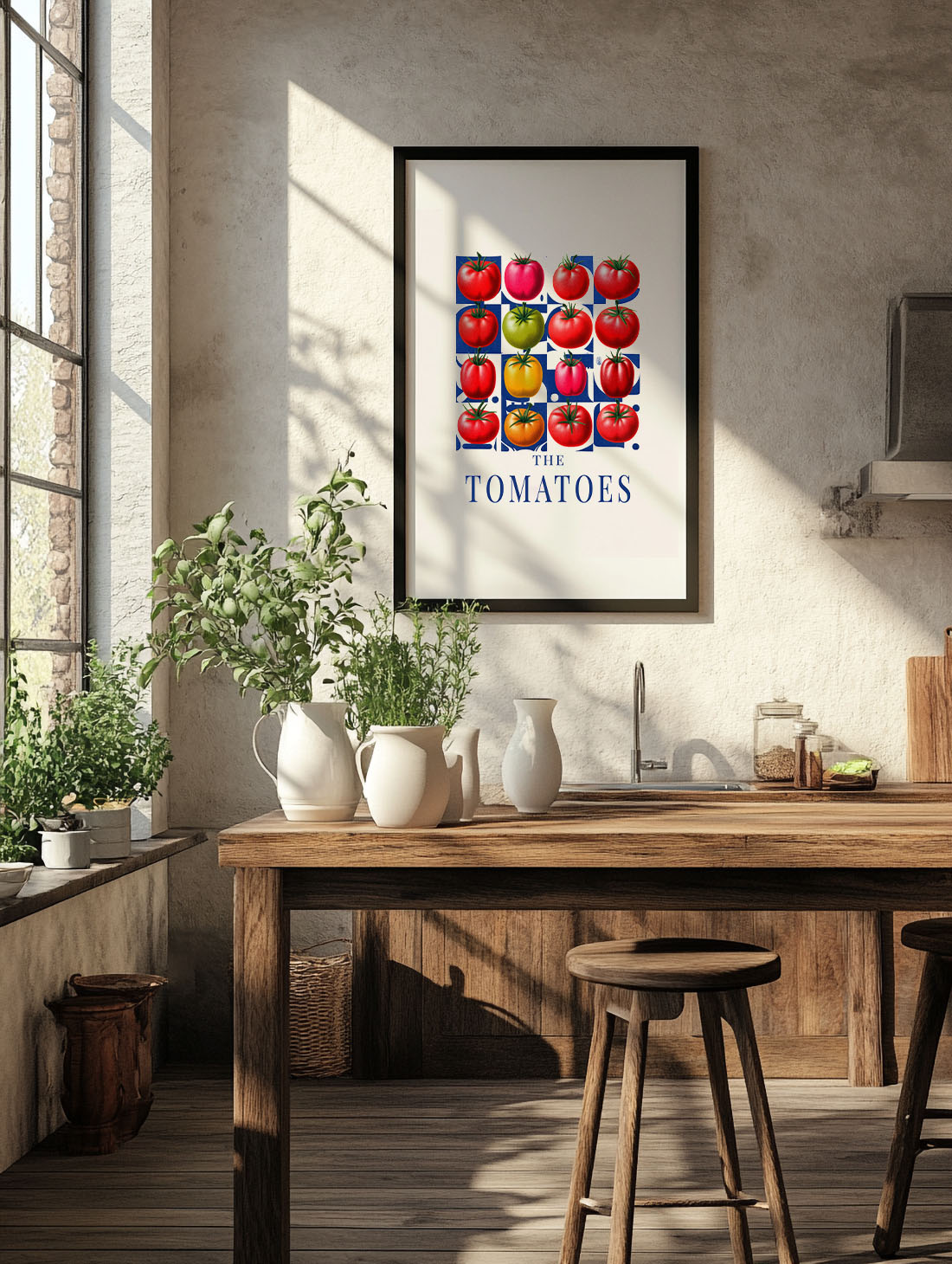
Kitchens tolerate smaller formats better than any other room — the visual field is fragmented by appliances, cupboards, windows. Here, a 30×40 cm or 40×50 cm print above a counter or beside a window reads correctly. Go larger and it fights with the room.
For dining rooms with generous wall space, treat them like a living room. A single statement piece opposite the table — something you look at over dinner — benefits from scale. 60×80 cm or 70×100 cm.
→ See the Kitchen Wall Art collection — from botanical prints to bold food art.
Hallway
Hallways are vertical spaces. Portrait-oriented prints work better here than landscape — they echo the proportions of the corridor. A 40×50 cm or 50×70 cm print creates a moment without blocking flow. Avoid anything too wide in a narrow hallway — it emphasises the pinch rather than the print.
Bathroom
Small format, high quality. A 30×40 cm print in a bathroom is an edit — it says something deliberate about the person who lives there. Don’t oversize it. Let it breathe.
Single Statement Piece vs. Gallery Wall
There is no wrong answer here — only wrong execution.
A single statement piece works when the artwork is strong enough to hold the wall on its own. It requires scale (70×100 cm minimum in a living room), confidence in the image, and restraint everywhere else. This is the Slim Aarons approach: one image, correctly sized, and the room is done.
A gallery arrangement works when you want to fill a larger wall, tell a richer story, or introduce multiple works from a collection. The key rules: keep consistent margins between frames (5–8 cm is the standard), align either the top edges or the centre line — never mix, lay the arrangement out on the floor before touching the wall, and ensure the total arrangement still respects the 2/3 rule relative to the furniture below.
Matte, Canvas or Framed: How Format Affects Perceived Size
Framed prints have a border — the frame adds visual mass. A 50×70 cm framed print reads larger on the wall than a 50×70 cm matte print. If you want maximum presence from a smaller size, go framed.
Canvas prints have depth — the 2 cm stretcher bar adds a sculptural quality. They read well in spacious rooms and hold their own without a frame.
Matte prints are the most flexible. The white border gives you freedom to frame however you want later, and they can be pinned, taped, or leaned rather than hung — which works well in spaces where you’re still figuring out the arrangement.
The Most Common Mistakes
Going too small. By far the most frequent error. A print that looks substantial online can feel modest on an actual wall. When in doubt, size up.
Hanging too high. Art should be at eye level — the centre of the print at roughly 145–160 cm from the floor. Most people hang 20 cm too high.
Ignoring the furniture. A large print above a small console looks mismatched. Scale the art to the furniture, not just the wall.
Mixing frame styles. If you’re doing a gallery wall, pick one frame finish and stick to it. Mixing black, white, wood and gold rarely works unless you have a very specific eye.
The Atelier Marbella Size Guide
All prints in our collection are available from 30×40 cm to 70×100 cm. Here’s how to read the range:
| Size | Best for |
|---|---|
| 30×40 cm | Bathroom, bedside, kitchen accent, hallway |
| 40×50 cm | Desk area, small bedroom wall, gallery wall component |
| 50×70 cm | Bedroom feature, above console, gallery anchor |
| 60×80 cm | Living room sofa wall, dining room |
| 70×100 cm | Statement piece, large living room, master bedroom above bed |
→ Shop the full collection — free delivery across Europe.
One Last Thing
The best print you can buy is one that fits the wall it’s going on. Not one that fits an idea of the wall, or a memory of how large that wall felt when you were last standing in front of it.
Measure first. Choose second. Hang with conviction. This art print size guide exists so you never have to guess.
Read also: How to Build a Gallery Wall
FAQ
What is the most popular art print size?
50×70cm is the most ordered size — it’s versatile enough for most rooms and positions. But for living rooms and dining rooms, 70×100cm is the more correct choice and produces better results.
Can a print be too large?
Rarely — but yes. A print that fills more than 80% of a wall’s width in a small room can feel oppressive. Leave at least 15–20cm of wall visible on each side of a print. If the print would touch the ceiling, it’s too tall for that wall.
What size print for above a sofa?
The print should be 60–75% of the sofa’s width. Above a standard 200cm sofa, that means 120–150cm of print width — a 70×100cm portrait print, or two prints hung as a pair to achieve that total width.
How high should a print hang?
The centre of the print should sit at eye level — approximately 145–150cm from the floor in a standing room, 120–130cm in a dining room (where you’re seated). In a hallway, hang slightly lower: you’ll encounter the print at close range, and lower placement feels more intentional at that distance.