
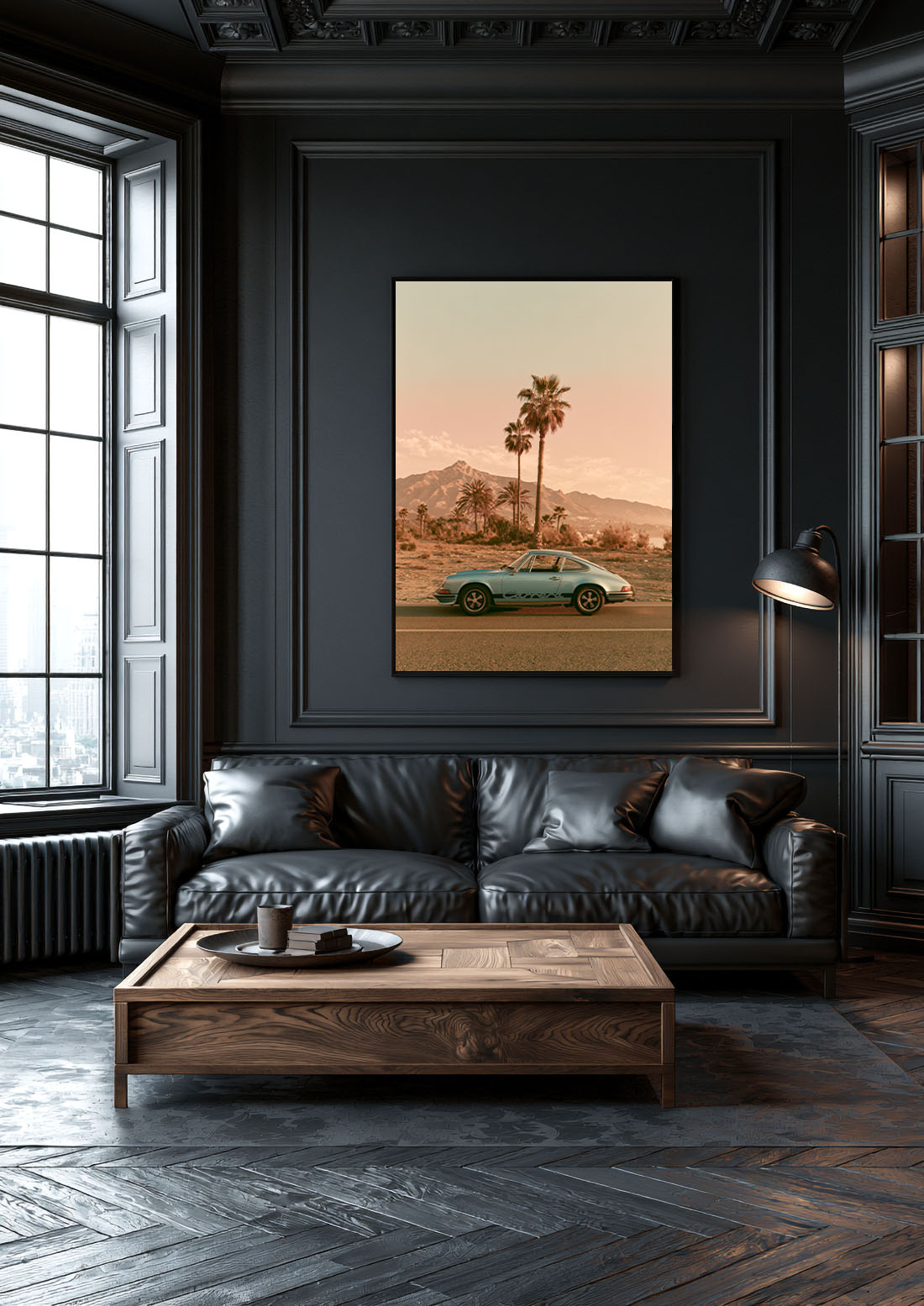
Vintage car posters occupy a category that most interior design guides either ignore or get wrong. They get ignored because the category is assumed to belong to garages and teenage bedrooms. They get wrong because when they do appear, they’re treated as decoration — as nostalgia — rather than what the best of them actually are: genuine graphic art with a visual intelligence that holds up across decades.
The gap between a great automotive art print and a generic car poster is vast. One transforms a room. The other fills a wall. This guide is for people who want the former.
Why Vintage Car Posters Work as Serious Interior Art
The argument for automotive art as serious interior design isn’t difficult to make if you look at the right work. A Porsche 911 rendered in precise detail against the Mediterranean coast isn’t a car picture — it’s a study in form, colour and light. A Ferrari 250 GTO at Le Mans isn’t racing memorabilia — it’s a composition with the same visual intelligence as any gallery-quality print.
What makes the best vintage car posters work in a modern interior is exactly what makes any great print work: deliberate composition, a considered palette, and a subject with enough visual weight to command a wall without demanding explanation.
There’s also something culturally specific about automotive art that the best examples capture. Cars of the 1950s, 60s and 70s weren’t just transportation — they were objects of genuine design ambition, shaped by people who cared about how a thing looked at speed, how it sat at rest, what it communicated in silhouette. That ambition is legible in the best automotive prints, and it’s what separates them from the generic.
The Four Eras of Automotive Poster Art
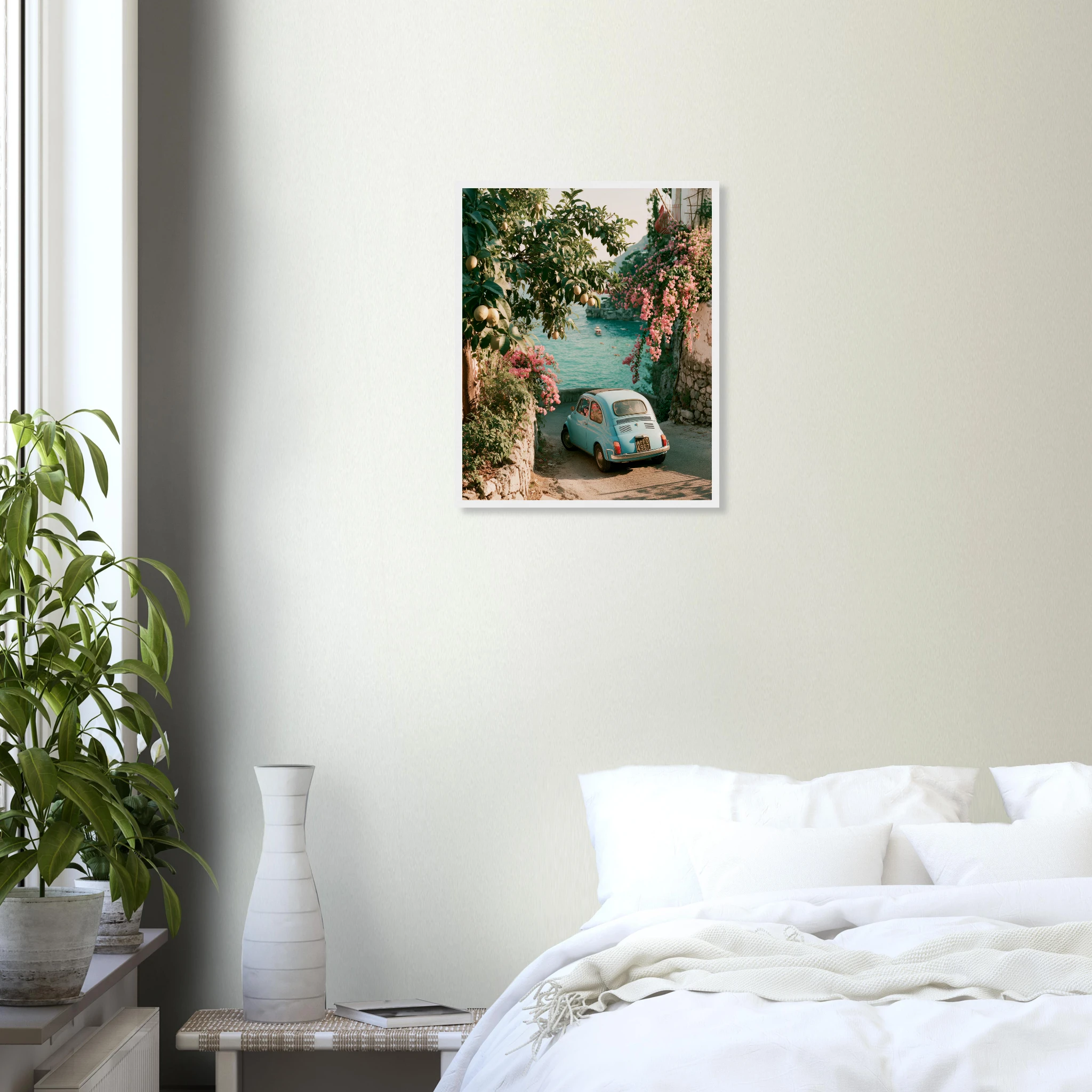
Understanding where a car print comes from — visually and historically — changes how you read it and helps you choose the right piece for a space.
The Racing Era (1950s–1960s)
The golden era for automotive graphic art. Le Mans, Monaco, Monza — race posters from this period are among the most collectible graphic objects of the twentieth century. Bold typography, flat colour, high contrast. Designers like Geo Ham and Michael Turner produced work that functions as pure graphic design, with the car as subject rather than hero.
This era translates best into spaces with a mid-century aesthetic: clean lines, natural materials, a preference for craft over excess.
The Road Car Era (1960s–1970s)
The period when road cars became cultural objects. The Ferrari Daytona, the Lamborghini Miura, the Porsche 911 — these cars existed at the intersection of industrial design and art, and the photography and illustration of the period reflects that. The best prints from this era have a quality that reads as lifestyle as much as machinery: a Slim Aarons sensibility applied to automobiles.
For a Mediterranean interior — a villa, a terrace room, anywhere that carries warmth and light — this is the era that works best. The colour palette of 1960s and 70s automotive photography maps naturally to terracotta, ochre, dusty sage.
The Racing Poster Golden Age (1970s–1980s)
A period of extraordinary graphic ambition in motorsport branding. The works commissioned for Le Mans, for Formula 1 circuits, for Martini Racing and Gulf Racing were produced by artists with genuine visual intelligence. The Martini Porsche. The Gulf Ford GT40. These aren’t racing souvenirs — they’re poster art of the highest order.
This era suits living rooms and studies with a more graphic, design-forward sensibility. The high contrast and bold colour hold space on a large wall.
The Contemporary Automotive Art Revival (2010s–Present)
A growing movement of artists treating automotive subjects with the same seriousness as any other fine art subject. Hyper-detailed technical illustrations, minimalist silhouette work, expressive brushstroke interpretations of classic cars — the range is wide. The best contemporary automotive art is unafraid of its subject and sits comfortably alongside photography, abstraction, and figurative work.
Which Cars Actually Work as Art
Not all cars translate equally to wall art. The vehicles that work best share certain characteristics: a silhouette with genuine graphic strength, a colour history that maps to interior palettes, and enough cultural resonance to carry meaning beyond the garage.
Prints that work here: the Porsche 356 PSring Framed Print, the Ferrari & Spitfire Framed Print and the Amalfi Alfa Romeo Spider Framed Print — each available as a framed print, ready to hang. Browse the Cars collection for more.
Porsche 911 — the most versatile subject in automotive art. The silhouette is immediately readable at any scale, the colour range from Guards Red to Gulf Blue maps to almost any interior palette, and the cultural associations are precise: performance without ostentation, design that doesn’t date.
Ferrari 250 GTO, Daytona, F40 — peak visual drama. These cars have a graphic presence that justifies oversized prints. Best in spaces that can absorb their energy: large living rooms, generous hallways, spaces where the car can own the wall it’s on.
Lamborghini Miura, Countach — the most geometric subjects in automotive history. The wedge profile of the Countach is a natural fit for graphic, design-forward spaces. The Miura’s flowing curves suit a warmer, more organic interior context.
Classic racing liveries — Gulf, Martini, Rothmans. The colour combinations are extraordinary and largely ready-made for residential interiors. The Gulf blue and orange combination in particular has become one of the most influential colour pairings in modern interior design.
Le Mans and Monaco vintage race posters — the circuit itself as graphic subject. These work because the composition isn’t about a specific car but about the event, which gives them a broader legibility in a residential space.
How to Choose a Vintage Car Poster for Your Space
The decisions that matter are the same as with any art print — colour, scale, and composition — but with a few considerations specific to automotive subjects.
Match the car era to your interior style. A 1950s racing poster in a mid-century space is coherent. The same poster in a contemporary minimal interior creates visual tension. Contemporary automotive art tends to be more adaptable — the cleaner execution sits more comfortably across different interior styles.
Consider the colour palette first. The best automotive prints for residential use are those where the car’s signature colour maps naturally to your interior. A Guards Red Porsche in a room with warm terracotta tones. A Gulf Blue GT40 in a room with cobalt accents and white plaster walls. The print should belong to the palette, not contest it.
Scale matters enormously. Automotive art is one of the few categories where going larger is almost always correct. For a significant living room or study wall, 70×100cm is a realistic minimum; 100×140cm is where the subject really opens up.
Single subject vs. editorial. A single car print — one subject, clean background — has a very different energy from an editorial photograph that places the car in context: a road, a circuit, a coastal backdrop. The former suits minimal spaces. The latter suits rooms that carry more visual information and need a print with narrative.
Explore our car wall art collection — from Porsche 911 editions to Ferrari circuit prints, each piece designed for residential interiors.
Framing and Hanging Automotive Art
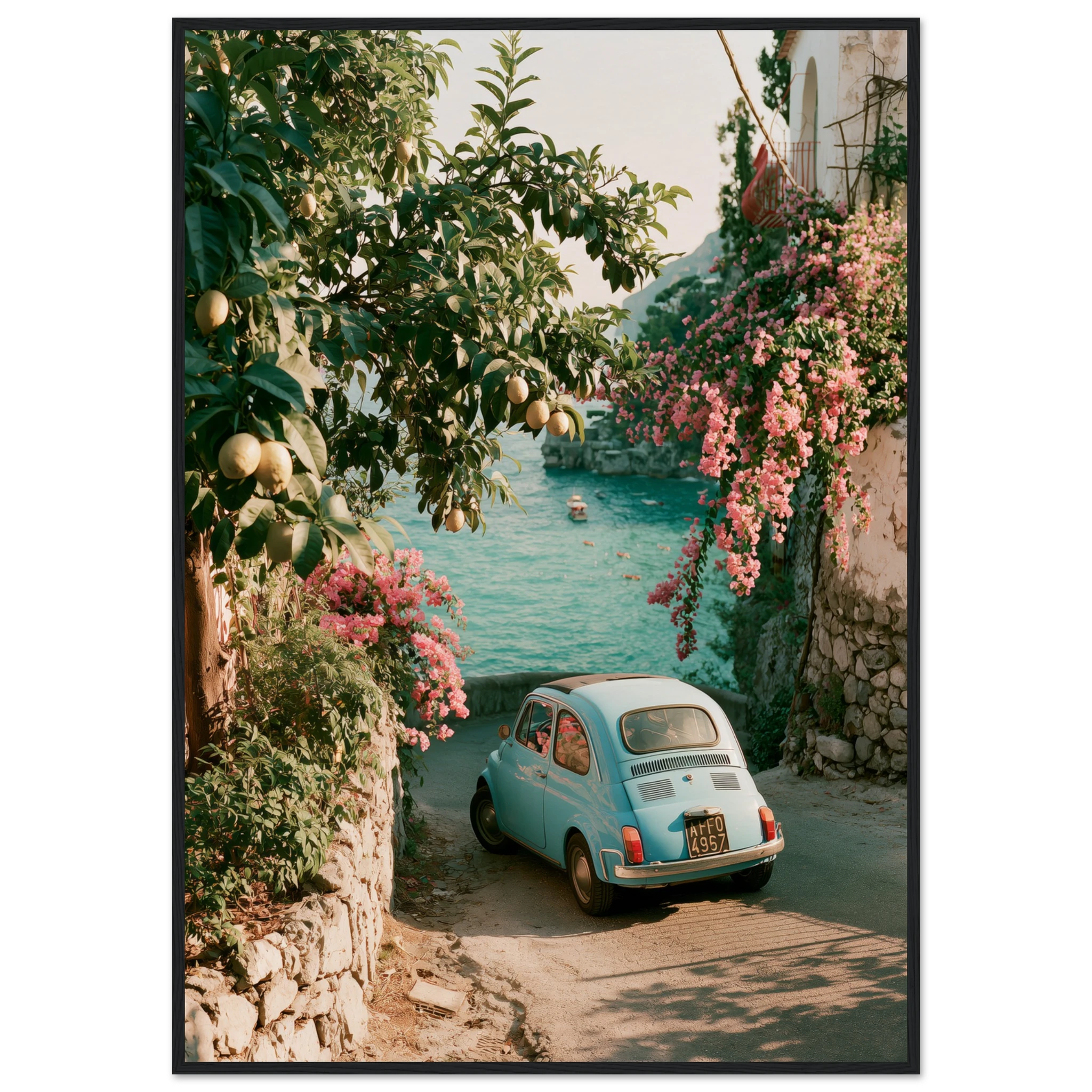
The framing decision for automotive art is more consequential than for most categories because the subject has specific visual weight that the frame either supports or undermines.
Thin metal or slim wood frames are the default for contemporary automotive prints. A thin brushed aluminium frame suits graphic, design-forward automotive art. A slim oak frame suits warmer, more editorial prints where the car is in context rather than isolated.
Black matte frames are the most versatile choice if you’re uncertain. They disappear into the composition and let the print lead.
Hanging placement: automotive prints work particularly well in hallways — the elongated space allows a large print to be encountered at the right distance. In a study or living room, hang at eye level as the primary focal point on the largest available wall. Avoid clustering automotive prints with other categories; they read best as singular statements or in a dedicated grouping of related subjects.
The Atelier Marbella Approach to Car Art
At Atelier Marbella, automotive art is treated as editorial photography first, car imagery second. The prints in our collection place classic subjects — Porsche 911, Ferrari, vintage race liveries — in the visual language of the Mediterranean: golden hour light, coastal backdrops, the colour palette of the Côte d’Azur and the Spanish costa.
The approach comes from a genuine conviction that the best automotive art isn’t about the machine in isolation but about what the machine represents: freedom of movement, design ambition, a lifestyle sensibility that translates from the road to the wall.
These aren’t prints for garages. They’re prints for rooms that take design seriously — and happen to love a great car.
FAQ
Are vintage car posters suitable for a living room?
Yes — when chosen correctly. The key is selecting a print with editorial quality rather than a generic car image. A well-composed automotive print with a considered colour palette sits as naturally in a living room as a landscape or abstract. Scale is also important: go large enough for the print to command the wall it’s on.
What car makes the best wall art?
The Porsche 911, Ferrari 250 GTO, and classic racing liveries (Gulf, Martini) produce the most visually compelling automotive art. They have silhouettes with genuine graphic strength and colour histories that map naturally to residential interiors.
How large should a vintage car poster be?
For a statement piece in a living room or study, 70×100cm is a working minimum. 100×140cm is where automotive art really opens up. Don’t go too small — automotive art loses its impact at small sizes.
Can car art work in a bedroom?
Yes, but the tone matters. A quiet editorial print — a 911 on a coastal road at golden hour, a Le Mans circuit poster in muted tones — works in a bedroom. High-octane race photography is better suited to living rooms and studies where it can be the dominant energy in the room.
Should I frame vintage car art?
A clean, simple frame always improves a print. For automotive art, a thin metal frame or slim black matte frame is the most effective choice. Avoid heavy or ornate frames — they create a historical mismatch with the subject.
Read Also
- Porsche Wall Art: The Definitive Guide
- Living Room Wall Art: The Statement Piece That Anchors a Room
- Large Format Prints: Why Going Big Changes Everything
- Gifts for Car Lovers: Wall Art They’ll Actually Hang
- Fiat 500 Wall Art: Little Car, Big Amalfi Style
- Cadillac Wall Art: American Chrome, Mediterranean Light