
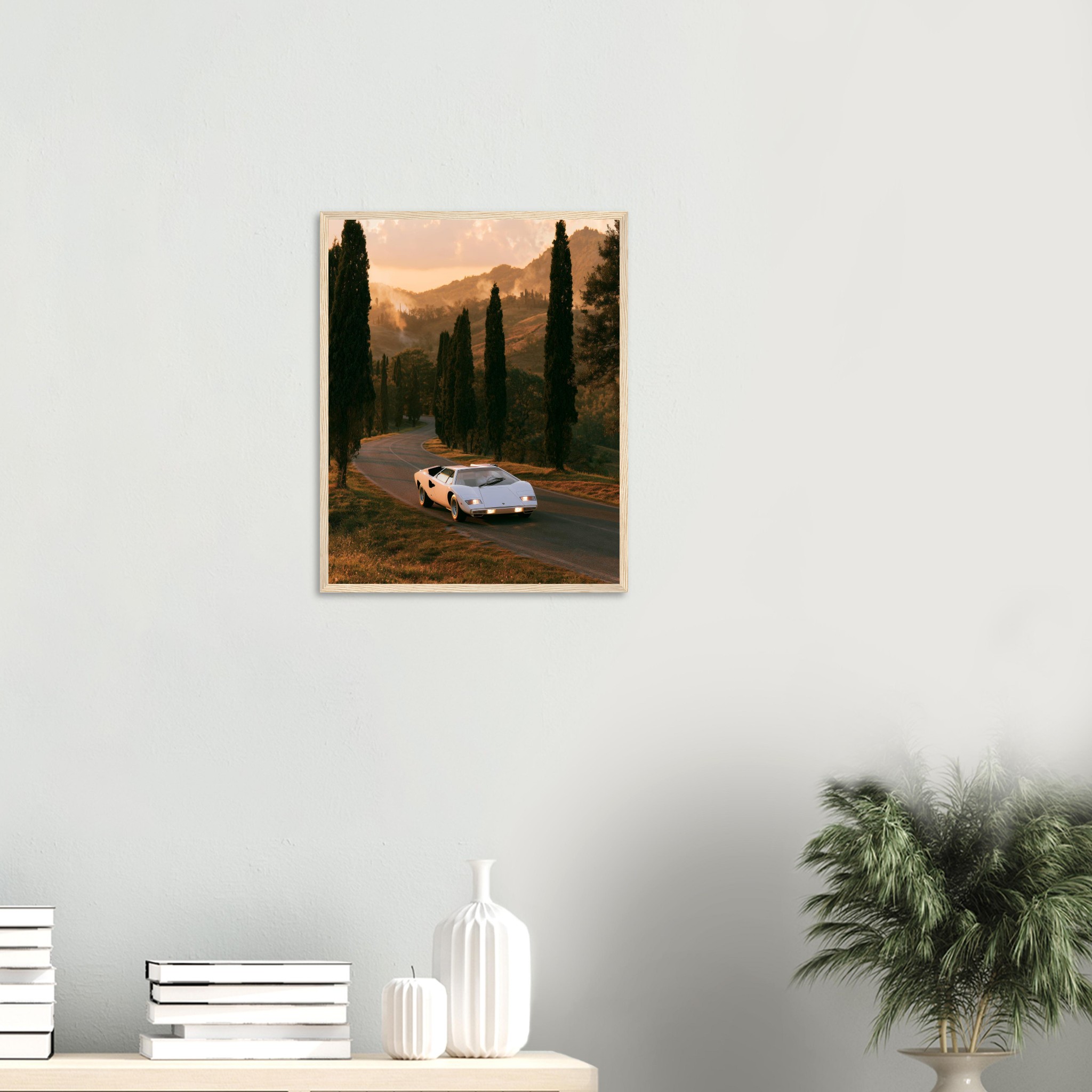
Lamborghini wall art has a strange kind of authority: the Countach never needed a driver in the frame to make a room feel faster. Long before anyone hung one as considered decor, it was already a poster — the wedge silhouette pinned above a teenage bed, shorthand for speed and ambition rather than an object anyone expected to see on gallery-white walls.
Why the Countach Became a Poster Before It Became a Classic
Marcello Gandini drew the Countach in 1971 as a study in flat planes and sharp angles, and it photographed like nothing else on the road. That flatness is exactly why it worked so well as a poster: no complex curves to lose in a printed reduction, just a clean wedge, scissor doors, and a stance that read instantly from across a room. An entire generation grew up with that print on their wall, and they are now the ones furnishing their own homes — with better taste, better frames, and a genuine reason to hang the car again, properly this time.
The Shape That Still Reads From Across a Room
Most modern supercars are sculpted in three dimensions — curved surfacing that needs light and shadow to make sense, which is exactly what gets lost when you flatten a car onto paper. The Countach has the opposite problem in the best possible way: it was designed as a wedge, so it survives the flattening. That’s the quiet reason it keeps working as wall art where photographs of rounder cars tend to go flat and lifeless. The proportions do the work; the print just needs to get out of the way.
Where Lamborghini Wall Art Works Best
This is not a print that needs a dedicated “car room” to justify itself, though it will happily anchor one. It reads just as well above a low sideboard in a masculine living room, alongside a turntable and a stack of records, or in a home office where it does the job a diploma usually does — a quiet signal of taste rather than a shouted one. A hallway leading to a garage is the obvious placement and still a good one, but a Countach print in a Marbella apartment, framed properly and hung at eye level, looks less like nostalgia and more like a considered piece of automotive art.
Canvas or Framed: Which Finish Suits a Supercar Print
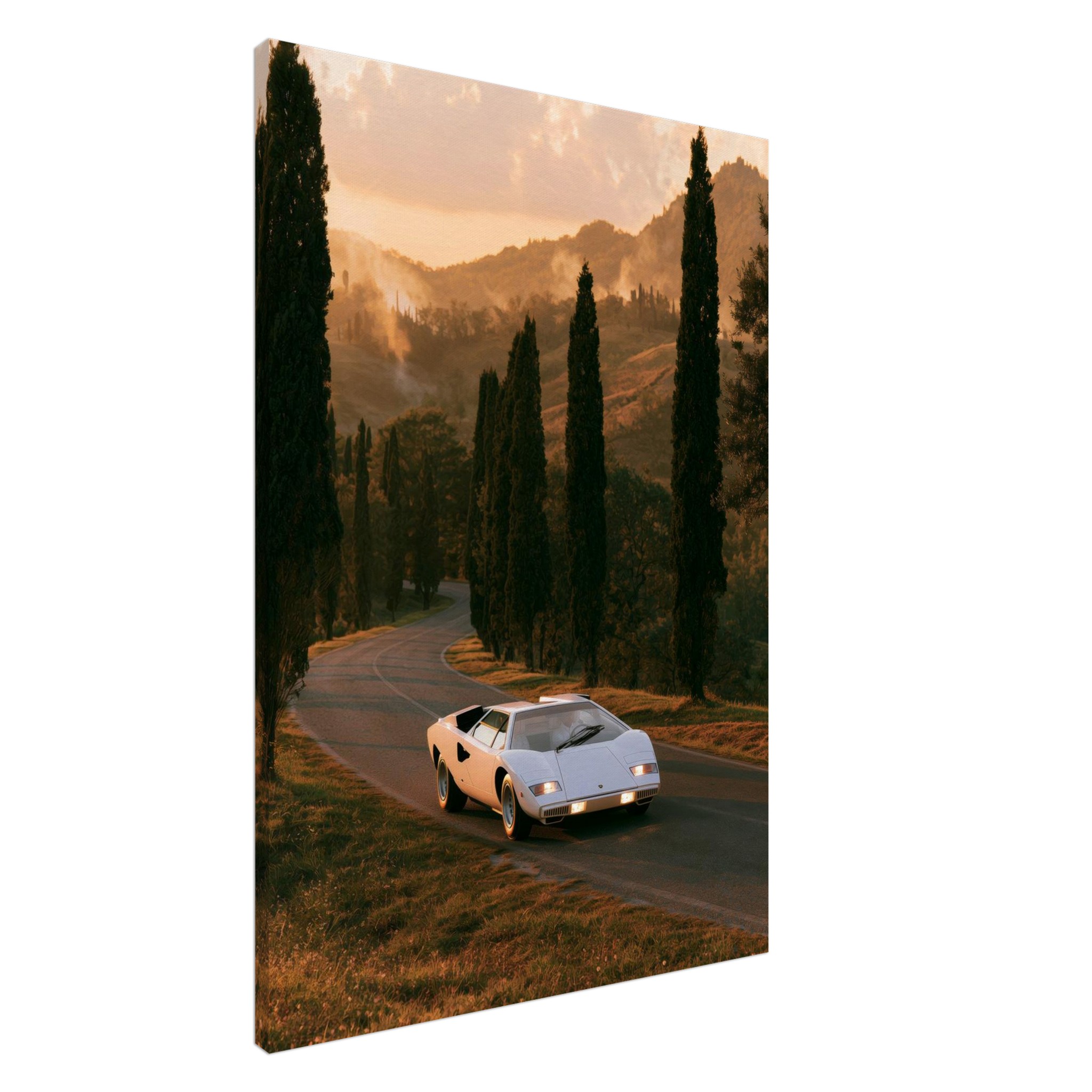
Canvas softens the print slightly, which flatters the warmer, filmic colour treatment we use on the Countach — it feels closer to a 1970s photograph than a digital render, and the texture reads well in a living room or bedroom where you want the piece to feel lived-in rather than pristine. Canvas also skips the glass, which matters in a room with a lot of natural light bouncing around. For an office or a hallway where the print needs to hold its own against harder edges — shelving, metal fixtures, a desk — the framed edition gives it more formal weight and a cleaner line against the wall.
Pairing It With Other Automotive Icons
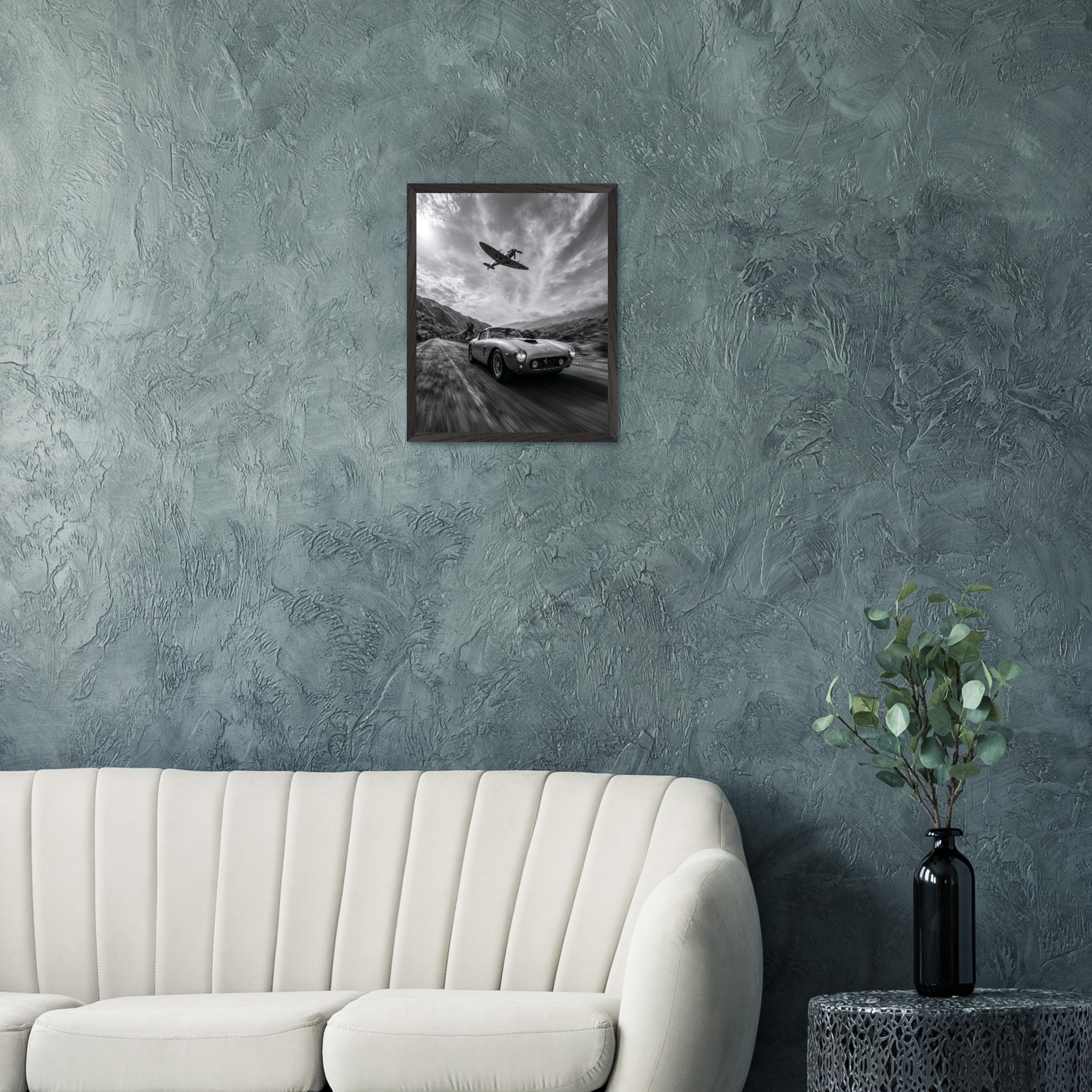
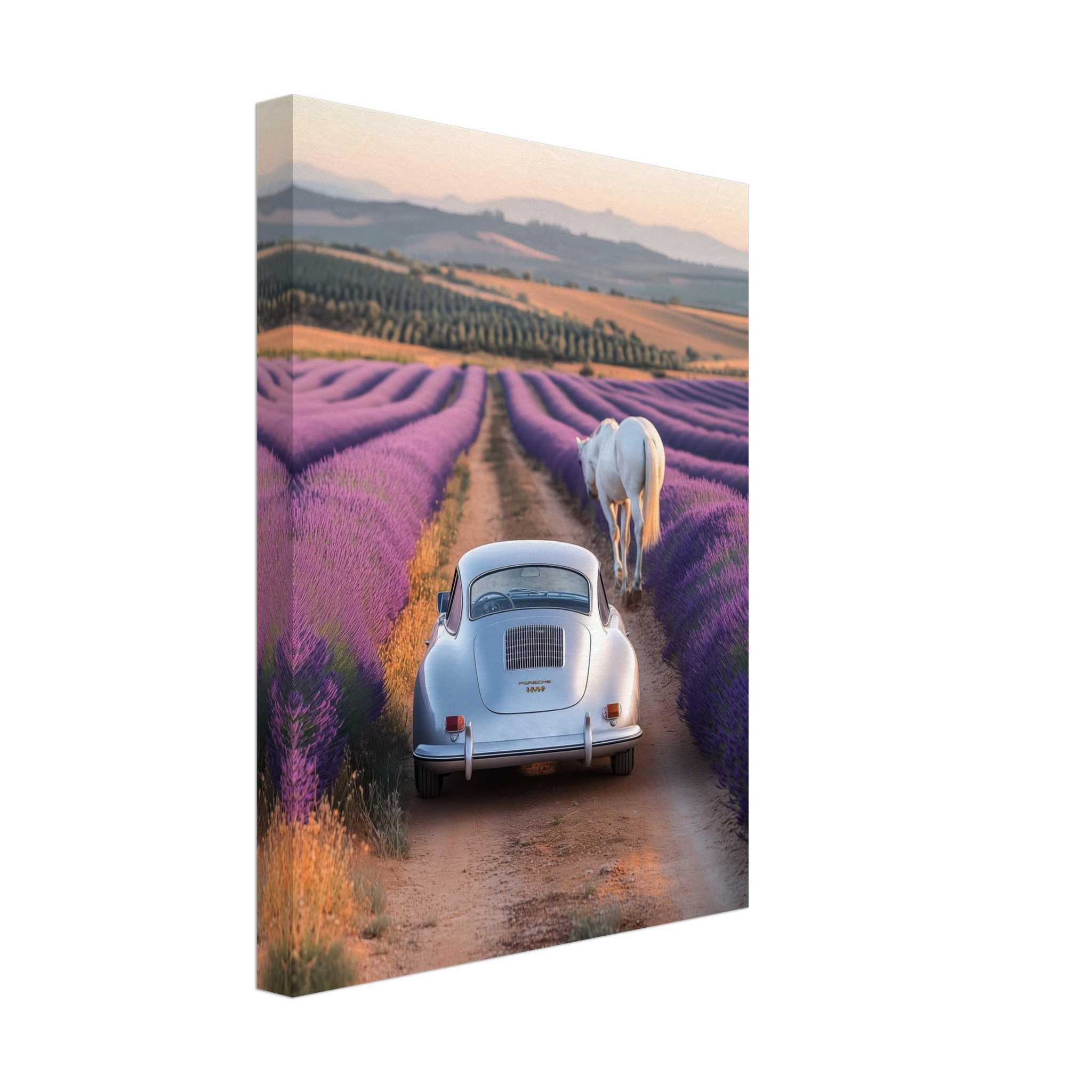
We only carry one Lamborghini at the moment — the Countach earns its place alone — but it sits naturally alongside our other automotive prints if you’re building a small gallery wall rather than a single statement piece. A Ferrari & Spitfire framed print brings in aviation-era glamour without competing for attention, and the Porsche 356 and Lavender Fields print adds a softer, more pastoral counterpoint — Provence rather than a pit lane. Mixed in threes, the wedge shape of the Countach becomes the anchor the other two compositions lean on. The full range lives in our car art prints collection if you want to see how the pairings actually sit together before committing to a layout.
Sizing a Poster-Era Car for a Modern Wall
The Countach’s low, wide stance wants a landscape orientation and enough width to let the proportions breathe — a small square print undersells the whole point of the car. As a single statement piece above a sideboard or a low bookshelf, a medium-to-large framed size reads best; scaled too small, it drifts back toward the dorm-poster territory it’s meant to have outgrown. If it’s going into a gallery wall with the Ferrari or the Porsche pieces above, keep it as the largest of the three — the composition holds together better when the wedge shape is doing the visual anchoring rather than fighting for space.
Frequently Asked Questions
Is a Lamborghini print too “boy’s room” for a living room?
It depends entirely on the frame and the finish. A canvas or a solid wood frame, hung at proper eye level and given room to breathe rather than crowded with other posters, reads as automotive art rather than adolescent decor — the difference is almost entirely in the presentation, not the subject.
What frame colour works best with the Countach print?
Black frames sharpen the wedge silhouette and suit a more formal room. Natural wood softens it and pairs better with the warmer canvas edition in a living room or bedroom setting.
Can I hang Lamborghini wall art next to other art styles?
Yes — its flat, graphic quality actually makes it easier to mix than most photography. It sits comfortably near botanical prints, typography, or a Mediterranean landscape piece as long as the frame finishes are kept consistent across the wall.
Does canvas or framed suit an office better?
Framed, generally. The cleaner edge and the glass give it a slightly more formal presence, which tends to suit a desk or a meeting-room wall better than the softer texture of canvas.