
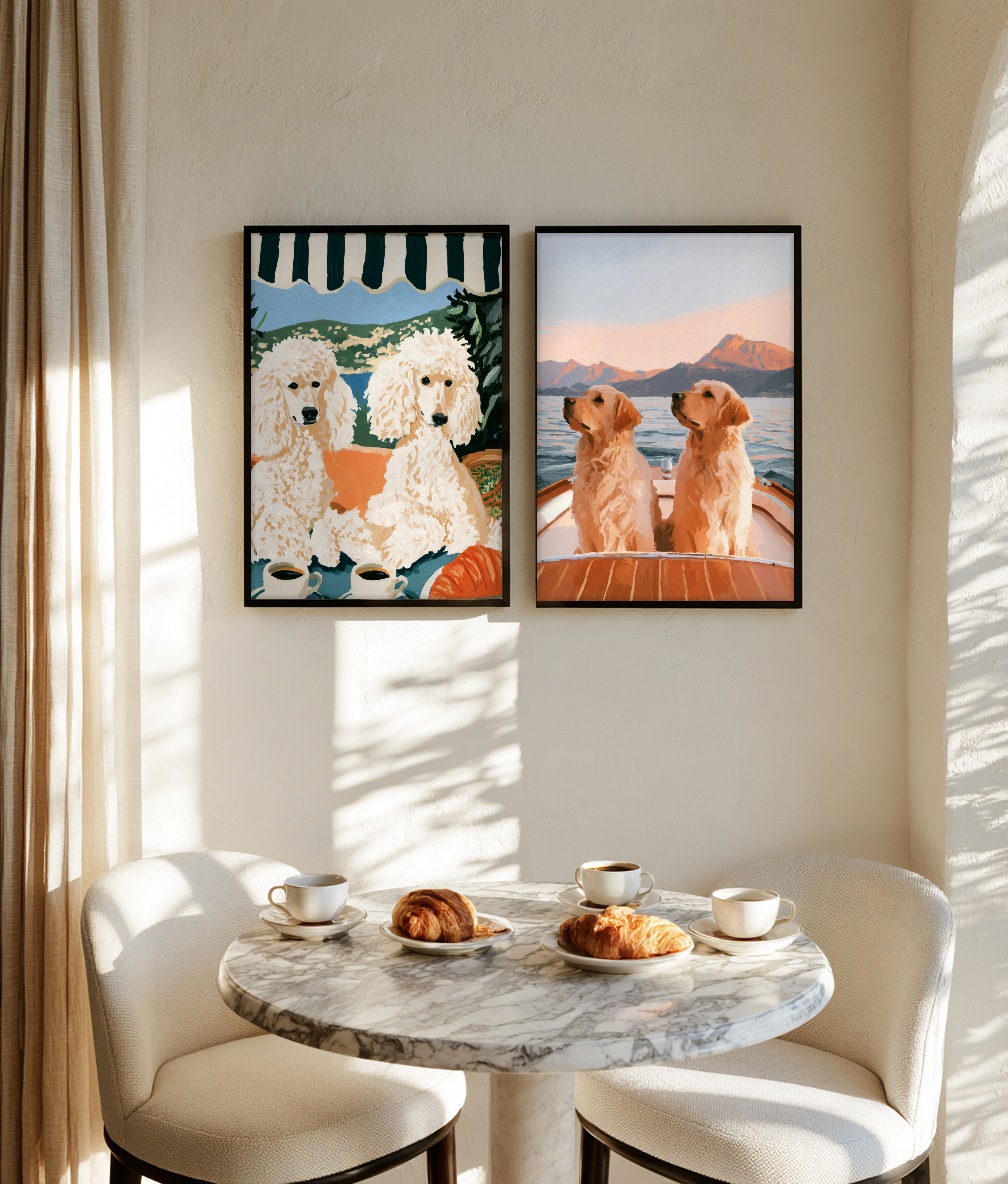
You can hang art without nails, and you can do it well. Most renters have a lease that says no holes, and plenty of owners simply dislike patching plaster. The good news is that five methods work reliably: removable adhesive strips, picture ledges, hanging rails, leaning, and pin hooks that leave almost no mark. This guide explains each one, gives the weight limits to respect, and shows which print suits which method.
Start with the weight, not the wall
Every nail-free method has a weight limit. Therefore, the first step is to know what your frame weighs. Weigh it on a kitchen or bathroom scale, then add a safety margin of about 30 percent. A small framed print is light. A large framed print is not, because the frame and the glazing add up quickly.
As a rule of thumb, smaller sizes such as 30×40 cm and 40×50 cm suit adhesive strips and pin hooks. Larger sizes such as 50×70 cm and 70×100 cm are better on a ledge, a rail, or leaning. If you are still choosing a size, our guide to art print sizes explains how each one looks on a wall.
Method 1: removable adhesive strips
Removable adhesive strips are the most popular choice for renters. They are sold in packs rated by weight, for example by 3M under the Command name. Use the pack rating as your ceiling, not as a target.
To get a clean hold, wipe the wall with an alcohol wipe and let it dry. Next, press each strip firmly for 30 seconds. Then wait an hour before you hang the frame. Avoid fresh paint, which needs several weeks to cure, and avoid textured walls or wallpaper, where the strip cannot grip.
When it is time to move, pull the strip tab slowly and parallel to the wall. In other words, stretch it like a rubber band instead of pulling it outward. This releases the adhesive without tearing the paint.
Method 2: a picture ledge or a shelf
A ledge is the easiest way to display heavy art. You lean the frame on the shelf, and the shelf carries the weight. Moreover, you can swap prints in seconds, which suits anyone who loves to rearrange.
Ledges still need fixing to a wall, so look for a freestanding version if holes are off the table. Alternatively, use a deep console, a mantel, or a low dresser. A large vertical print leaning on a sideboard looks relaxed and intentional.
Method 3: leaning, the no-hardware option
Leaning is the simplest method of all. Place the frame on a floor, a low shelf, or a windowsill and rest it against the wall. Layer two or three frames of different sizes for a gallery effect. For example, a tall framed print behind and a smaller one in front looks relaxed and collected.
Keep a few things in mind. First, protect the floor or shelf with felt pads. Second, place the frame where nobody will brush against it. Finally, add a small piece of removable putty at the bottom corners if you have pets or children.
Method 4: hanging rails and cord systems
Some renters use a tension rod or a floor-to-ceiling pole system, which holds without drilling. Others choose an adhesive hanging rail. Both let you hang several frames from cords or hooks and move them whenever you like. This is a smart route for a gallery wall when you cannot drill. Check the rated load of the rail and divide it by the number of frames before you start.
Method 5: pin hooks, the near-nail-free choice
Strictly speaking, a pin hook is not nail-free. However, the hole it leaves is tiny, and a dab of spackle or toothpaste hides it. Pin hooks suit light frames, usually under a couple of kilos. If your landlord allows small holes, this is the neatest hold of all. If not, stay with strips or ledges.
Which print for which method
Here is how we would pair a few of our framed prints with the methods above.
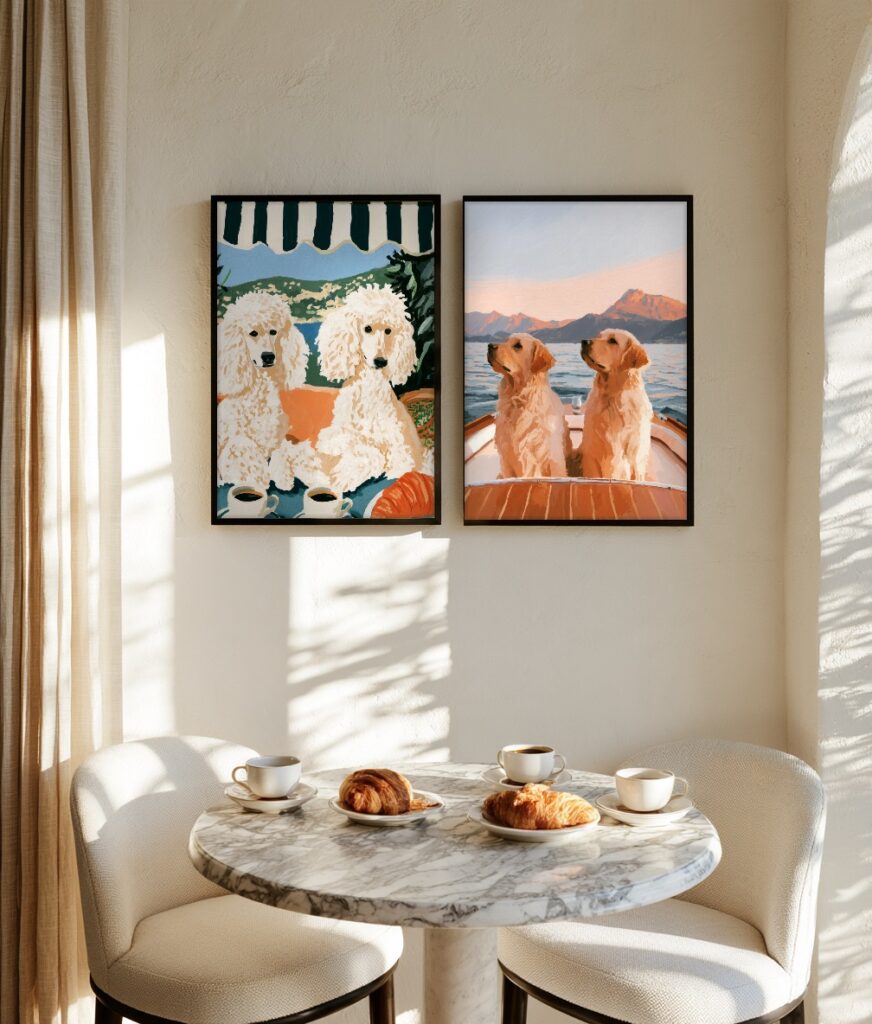
- Poodles and Croissants, Riviera Café is a bright, cheerful print that works well in a smaller size on adhesive strips in a kitchen or breakfast corner.
- Golden Retrievers on the Riva, Lake Como has a calm palette. In a larger size, it looks lovely leaning on a console in a hallway or bedroom.
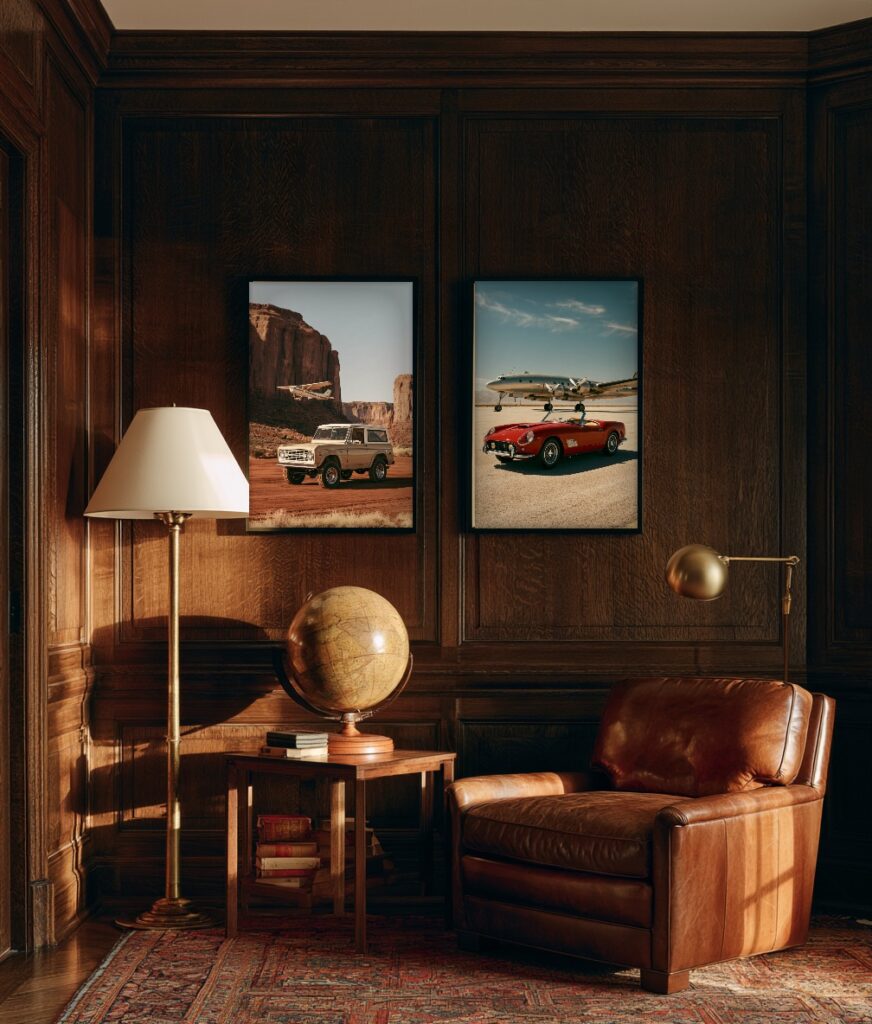
- Ford Bronco and the Cessna, Monument Valley has a dark, warm mood that suits a rail or ledge above a desk or sofa.
- The Flooded Gallery, Ocean Baroque is a dramatic piece. A large size leaning on a deep shelf makes a strong statement without a single hole.
Alternatively, pick two prints that go together. Our Perfect Pairs are ready-made sets of framed prints with an automatic discount, and two matching frames side by side look great on a pair of adhesive strips. You can also browse the full animal prints and car prints collections.
Common mistakes to avoid
Most failures come from the same few errors. People skip the cleaning step, they ignore the weight rating, or they hang the frame too soon. In addition, many people use strips on a wall that is humid, such as a bathroom, where adhesive struggles. When in doubt, choose a ledge.
Finally, always test one strip in a hidden corner first. Some paints peel easily, and it is better to find out on a small patch than behind a favorite frame. For more on frames themselves, see our complete guide on how to frame a print.
Frequently asked questions
Can adhesive strips damage paint?
They can on poor paint or fresh paint. Use them on fully cured, well-bonded paint, remove them slowly by stretching the tab parallel to the wall, and test a hidden spot first. If the paint is flaking, choose a ledge or leaning instead.
How heavy a frame can I hang with strips?
Only as heavy as the pack rating allows. Weigh your frame, add a 30 percent margin, and use more strips if needed. Large framed prints are usually safer on a ledge, a rail or leaning.
Is leaning art on a shelf secure?
Yes, if the shelf is deep, level, and out of the way. Felt pads stop sliding, and removable putty at the bottom corners adds stability in a home with pets or children.
What is the best way to hang a large print without nails?
Lean it. A large print on a sideboard, console, or floor ledge needs no hardware and looks very modern. A hanging rail is the second-best option for big frames.
Read also
Gallery Wall: 5 Ways to Build One That Actually Works · Gallery Wall Ideas 2026: Beyond the Basic Grid · Poster vs Art Print: What’s the Difference?
More prints to explore: